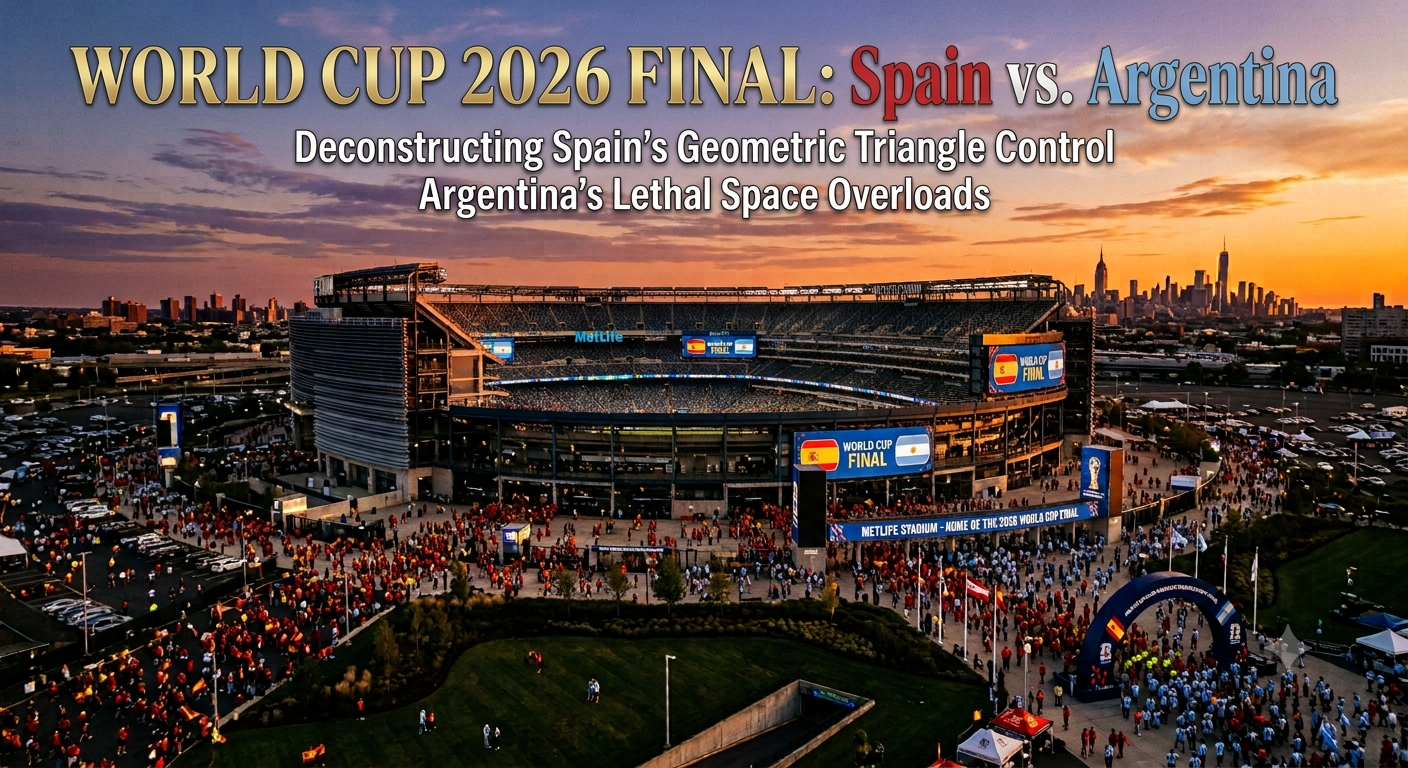
Clear the workspace and pick up your analytical markers, because we have reached the absolute mountaintop of international football. Forget the media scripts tracking historical narratives; for those who love deep tactical geometry, this FIFA World Cup 2026 showdown at MetLife Stadium between Spain and Argentina is the ultimate dream chessboard. We are looking at a historic tactical template: the reigning European champions colliding directly against the defending world title holders in the highly anticipated 2026 World Cup Final.
As an analyst tracing how both frameworks have navigated their bracket arcs, I see this clash as an explicit division in styles. Luis de la Fuente has guided Spain through a period of absolute control, relying on rhythmic, horizontal possession to tire out defensive lines. Lionel Scaloni, by contrast, has built an Argentina setup that embraces elite structural chaos—surviving grueling extra-time hurdles and staging dramatic late-game tactical modifications to pick locks. This tactical battle will determine who walks away from the FIFA World Cup 2026 as the undisputed kings of global football.

Let’s tear down the tactical system maps, the pressing lines, and the microscopic spatial zones that will determine the trophy’s destination.
The Generational Flank War: Lamine Yamal vs. Argentina’s Left Squeeze
The most volatile area of the pitch sits directly in Spain’s right attacking channel, where 19-year-old sensation Lamine Yamal triggers isolation loops against Argentina’s defensive block. Spain uses a highly specific wide expansion model, pushing Yamal right to the touchline to stretch the opponent’s defensive lines horizontally. This battlefield will shape the early patterns of the 2026 World Cup Final.
To counter this, Scaloni will look to deploy an aggressive defensive squeeze. Nicolás Tagliafico won’t be left alone to handle the winger’s acceleration. Expect interior midfielder Alexis Mac Allister to drop deep into the half-space channel, constructing a two-man tracking wall designed to cut off Yamal’s signature inside passing routes.

If Argentina allows Yamal to drag their defensive shape outward, massive horizontal vacuums will form inside the area for Dani Olmo and Pedro Porro to exploit. Spain will deliberately use this side to anchor their offensive sequences, pulling the opponent out of balance before shifting the ball laterally across the turf during this historic FIFA World Cup 2026 showpiece match.
Rodri’s Squeeze Layer vs. The Messi Positioning Matrix
In the center of the pitch, the structural balance of the entire match depends on one massive battlefield: how Spain’s midfield anchor handles Lionel Messi. Rodri has operated as a human shield throughout the competition, organizing a 91% team passing accuracy that leaves opposing press lines chasing ghosts. This duel will anchor the technical narrative of the 2026 World Cup Final.
Messi’s current tactical profile is incredibly dangerous because he completely opts out of traditional running lines. The 39-year-old maestro spends large phases walking-drifting through the center circle, waiting for the exact moment the opposing midfield double pivot steps too high. Once Spain turns the ball over, Messi uses sudden vertical acceleration to turn into Zone 14, looking to deliver looping balls over the top to Julián Álvarez or Lautaro Martínez.

Rodri’s assignment is clear: he must maintain a disciplined defensive depth line, refusing to step out to press loose balls unless Fabián Ruiz has recovered his tracking post. If Rodri leaves the pocket exposed for a fraction of a second, Messi will slice through the back four with pinpoint precision, a scenario both managers have deeply prepared for ahead of the FIFA World Cup 2026 decider.
The Structural Pressing Systems and Rest-Defense Shields
Both technical staffs have constructed elite rest-defense structures to insulate their goalkeepers from dangerous transition scenarios throughout the FIFA World Cup 2026 tournament arc.
- Spain’s High-Line Trap: De la Fuente pushes center-backs Pau Cubarsí and Aymeric Laporte exceptionally high up the pitch, relying on goalkeeper Unai Simón to operate as an auxiliary sweeper-keeper to eliminate direct long balls. This system strangles the opponent’s possession space but leaves them highly vulnerable to rapid vertical counters if the initial press fractures.
- Argentina’s Central Shield: Scaloni prefers a highly combative, narrow three-man defensive anchor featuring Cristian Romero, Lisandro Martínez, and deep-screen Leandro Paredes. This layout is built to absorb heavy penalty-box pressure, functioning as a structural springboard that allows full-backs like Nahuel Molina to launch high-speed transition breaks the moment a turnover is secured. The balance between these shields will define who survives the pressure of the 2026 World Cup Final.
Late-Game Modifications and Substitution Volume
Because this tournament has pushed both squads through an intense physical grind, the opening 60 minutes will be a cagey tactical chess match. The real structural separation in the 2026 World Cup Final will arrive late in the second half through the deliberate use of substitute asset volume.
Scaloni has already proven his ability to completely rewrite his tactical shape under extreme pressure. If Argentina struggles to penetrate Spain’s geometric block, expect the sudden introduction of Lautaro Martínez and Nicolás González past the 70th minute to shift their base into a front-heavy, physical overload system.

De la Fuente will answer this pressure by using his own bench parameters, bringing on fresh ball-retention energy to the engine room. The manager who times his personnel rotations to preserve structural discipline will lift the trophy at the end of the 2026 FIFA World Cup.
The Core Tactical Performance Checkpoints
To track who is successfully dictating the structural terms of this match, watch these three explicit match metrics:
- Horizontal Pass Volume: If Spain keeps their pass circulation numbers high inside the middle third, they will gradually wear down Argentina’s narrow midfield lines.
- Turnover Recovery Zones: If Argentina forces errors inside Spain’s half, they will immediately bypass Rodri’s tracking screen, creating instant isolation targets for Messi.
- Wide Corridor Tracking Speeds: How well Argentina’s wide options recover defensively to stop Porro and Cucurella from creating flank overloads will determine the box’s stability.
Over to You: Will Spain’s flawless geometric triangle circulation successfully isolate the defending champions, or will Lionel Scaloni’s relentless space overloads pave the way for Lionel Messi to secure back-to-back world titles? Drop your precise tactical breakdowns and win prediction in the comments below!



Leave a Reply