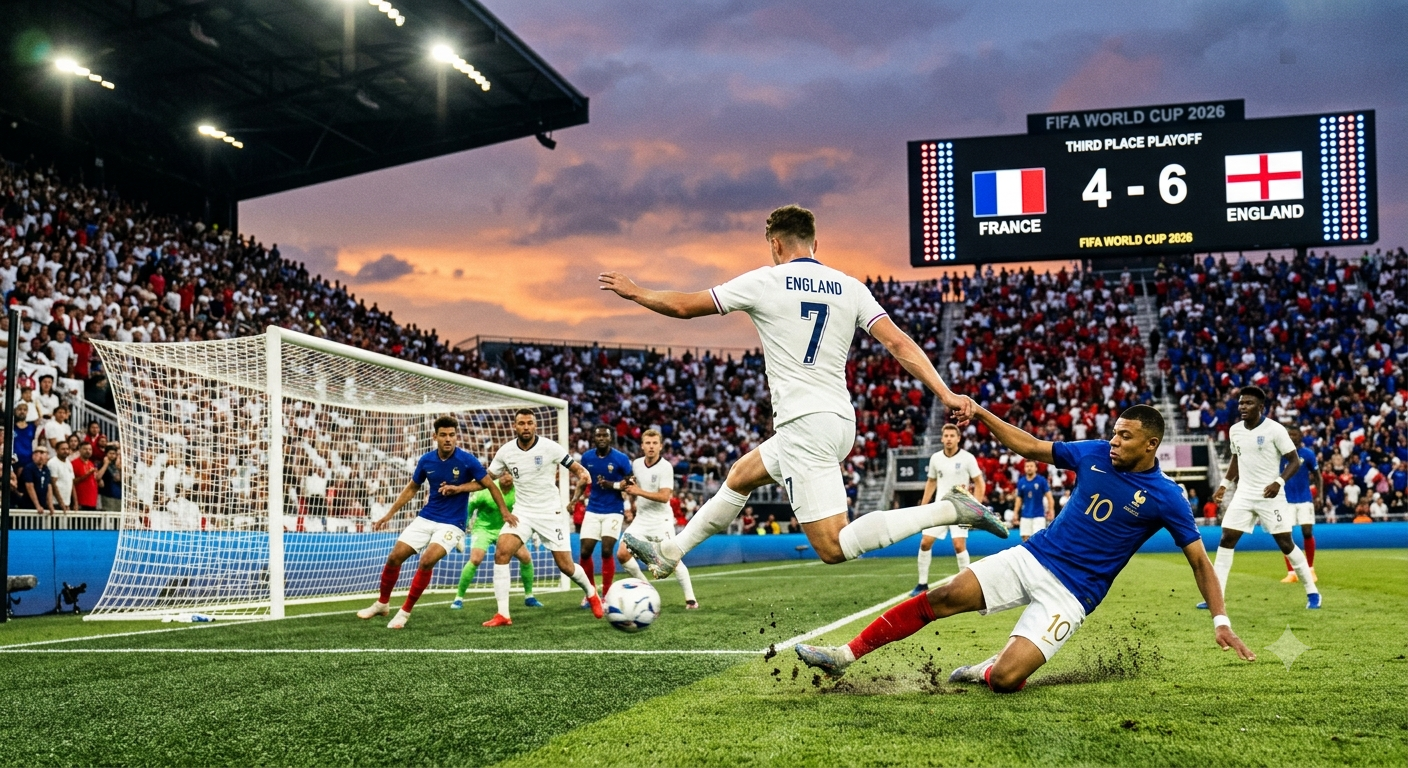
The final consolation fixture of the tournament is historically dismissed as the match nobody wants to play. When the dream of lifting the golden trophy vanishes just a few days prior, walking out onto the pitch brings a specific kind of emotional fatigue. Yet, what unfolded on the Florida turf inside Miami Stadium completely shattered expectations.
This specific third-place playoff became an instant classic. France vs England did not just turn into a standard tournament wrap-up; they produced a ten-goal thriller that enters the record books. England’s breathless 6-4 victory to seal the bronze medal provided a spectacular look at what happens when elite tactical systems drop their defensive handbrakes and play with total attacking freedom.
From the press box tracking grids, this high-scoring game presented a fascinating puzzle of two completely distinct halves. Let’s break down the wide corridor systems, the structural adjustments, and the individual milestones that defined this unforgettable installment of the FIFA World Cup 2026.
Tuchel’s Opening Blitz: Overrunning the French Shape
Exploiting the Disjointed French Screen
Thomas Tuchel promised a strong reaction following the painful semifinal exit against Argentina, and his first-half blueprint worked with high efficiency. With Harry Kane on the bench to manage physical fatigue, Ivan Toney anchored the frontline, flanked by the pace of Marcus Rashford and Bukayo Saka. England looked like the side with everything to prove, while France appeared to be dealing with a massive semifinal hangover in this high-scoring third-place playoff.
The tactical script fractured in favor of the Three Lions just 134 seconds into the match. French youngster Désiré Doué played a loose lateral pass across the midfield line, which was intercepted by Declan Rice. Taking advantage of the disorganized French shape, Rice drove forward and unleashed a brilliant long-range strike from outside the box that left Mike Maignan stranded.
Squeezing the High Defensive Line
France, operating in a narrow 4-1-2-3 shape with Maxence Lacroix filling in for the injured William Saliba, struggled to track the horizontal switches. In the 18th minute of this dramatic France vs England clash, Rice turned provider, curling an absolute peach of a corner into the six-yard box. Center-back Ezri Konsa read the flight perfectly, out-jumping Adrien Rabiot to head home a powerful second to push the lead to 2-0.
With the French defensive lines pushed high to hunt for a response, the opposing wingers found open grass everywhere. Morgan Rogers and Eberechi Eze pulled the strings from deep, sliding vertical passes into the wide channels. In the 37th minute, a rapid counter-attack found Bukayo Saka breaking clear into the right corridor. Saka cut inside Theo Hernández with ease to slot a low finish into the corner, before striking again in first-half stoppage time off a quick Eze pass. England walked into the tunnel with a stunning 4-0 lead, leaving the French contingent looking shell-shocked.
The Halftime Reset: Deschamps’ Final Tactical Shift
Activating the Left Half-Space
Didier Deschamps, taking charge of the French national team for the 187th and final time, refused to let his iconic 14-year managerial tenure conclude in an embarrassing blowout. Labeling the first-half display “catastrophic,” Deschamps triggered a massive structural modification at the break. He made four substitutions, introducing Lucas Digne, Dayot Upamecano, Ousmane Dembélé, and Bradley Barcola to salvage the match.
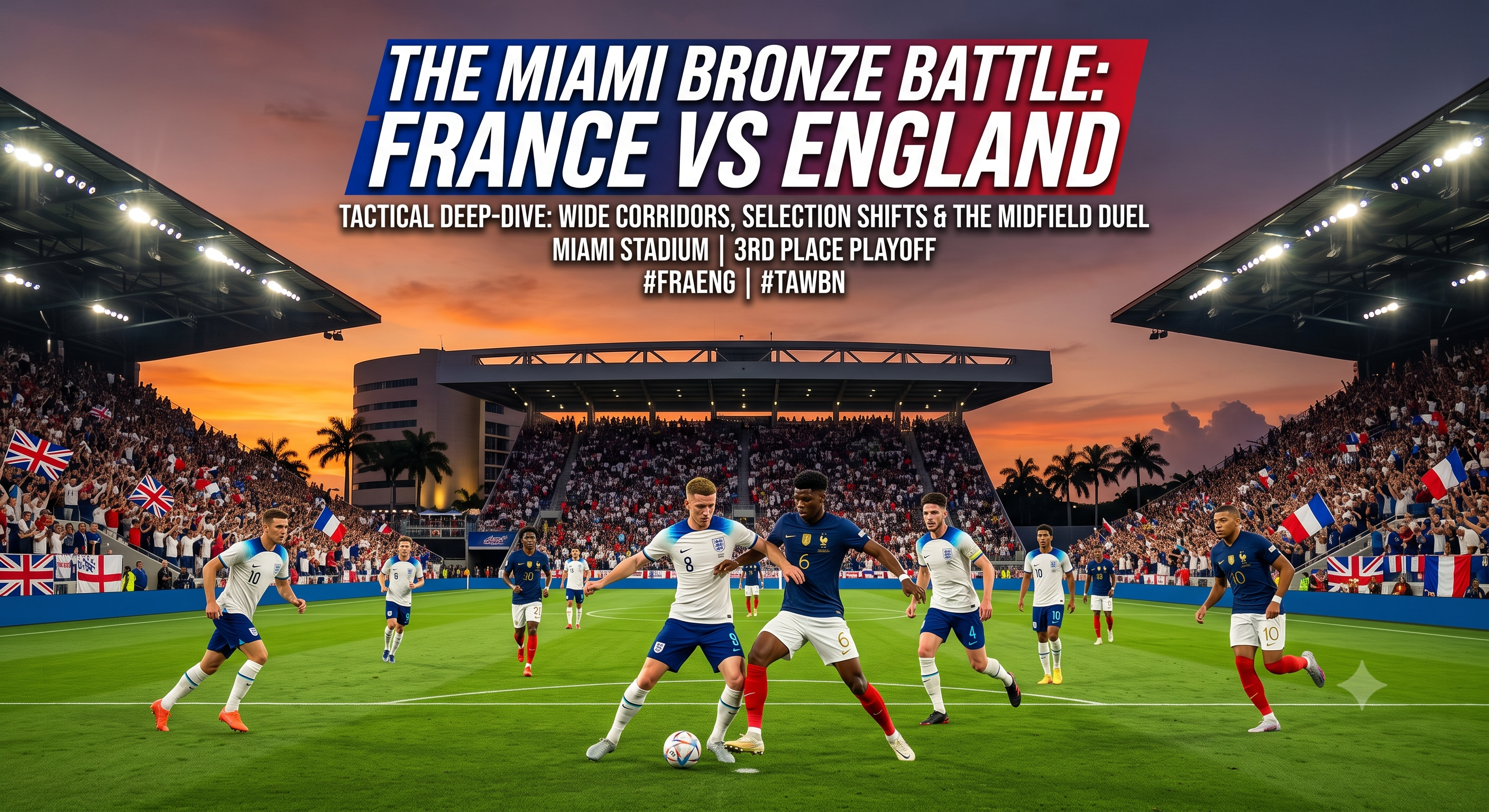
The adjustment altered the complexion of this France vs England battle. France abandoned their slow build-up patterns, shifting instead to a high-tempo wide corridor squeeze. Barcola and Kylian Mbappé pinned themselves to the left half-space, exploiting the lack of coverage tracking from the rotated full-backs.
Executing the Quick-Fire Repayments
The impact was instantaneous on the pitch. In the 48th minute, Michael Olise picked up the ball in midfield and threaded a pinpoint through-ball past Jarell Quansah. Mbappé latched onto it, flicking a clinical finish past Dean Henderson to bring the score to 4-1.
Just six minutes later, the defense wobbled again. Barcola intercepted a sloppy pass in the middle third, exchanged quick passes with Olise, and sprinted clear to fire home a low strike. The tactical shield built in the first half was rapidly disintegrating under relentless French pressure in this unforgettable FIFA World Cup 2026 fixture.
History in Miami: Mbappé’s Record & Saka’s Hat-Trick
Breaking the All-Time Scoring Record
By the 66th minute, the Miami Stadium atmosphere reached a fever pitch as pure history was written on the turf. Olise, registering his record-breaking seventh assist of the competition, found Mbappé hovering on the edge of the 18-yard box. The superstar unleashed a rocket of a left-footed shot that beat Henderson at the near post, reducing the gap to 4-3 and changing the course of this third-place playoff.
With that brilliant strike, Kylian Mbappé officially scored his 22nd career World Cup goal, overtaking Lionel Messi to become the all-time leading goalscorer in tournament history. It was a legendary moment wrapped inside an absolute battle for survival at the FIFA World Cup 2026.
The All-Time World Cup Goalscoring Leaderboard:
- Kylian Mbappé — 22 Goals
- Lionel Messi — 21 Goals
- Miroslav Klose — 16 Goals
Restoring the Midfield Cover-Shadows
With the team rattled, Tuchel realized he had to inject experience to steady the structural dam. In the 78th minute, he made a double switch, bringing on Elliot Anderson and Jude Bellingham to restore defensive cover-shadows in midfield.
Relief arrived in the 86th minute. Djed Spence triggered a rare second-half counter-attack, driving into the French box before being brought down by a challenge from Malo Gusto. Bukayo Saka stepped up to the spot under pressure, sending Maignan the wrong way to secure his magnificent hat-trick and hand his team a brief 5-3 cushion.
Stoppage-Time Drama: Bellingham’s Definitive Blow
Answering the Final French Surge
The final ten minutes proved that this intense France vs England encounter was operating in a matrix of absolute chaos. Refusing to back down, France pushed numbers forward in the 96th minute. Ousmane Dembélé picked up a loose clearance on the wing, danced past Trevoh Chalobah, and fired a spectacular effort into the top corner, pulling France back within one at 5-4.
Delivering the Solo Clincher
With the entire stadium holding its breath for an equalizer, the player of the tournament delivered the definitive blow in the 98th minute. Jude Bellingham collected the ball deep inside his own half, shrugged off a challenge from N’Golo Kanté, and went on a spectacular solo run. Bellingham wove past multiple blue shirts before coolly slotting the ball home to seal the unbelievable 6-4 victory.
The goal marked Bellingham’s seventh of the competition, cementing a place on the podium and securing the best finish at the global finals since the legendary 1966 victory on home soil. It was the perfect conclusion to an unforgettable third-place playoff that completely lit up the FIFA World Cup 2026.
The Tactical Autopsy: Key Match Indicators
Analyzing Midfield Spacing Vacuums
The absence of a traditional anchoring low block from both teams allowed attacking midfielders like Olise and Bellingham to control the match tempo at will during this France vs England meeting.
Countering Flank Overloads
The second-half French resurgence was entirely generated by overloading the full-backs out wide, pulling Quansah and Konsa completely out of central alignment.
Evaluating Bench Impact
Tuchel’s tactical choice to introduce Bellingham and Anderson in the final quarter-hour stopped the bleeding in Zone 14, providing the defensive stability needed to hold off the final French charge in this legendary match of the FIFA World Cup 2026.
Leave a Reply