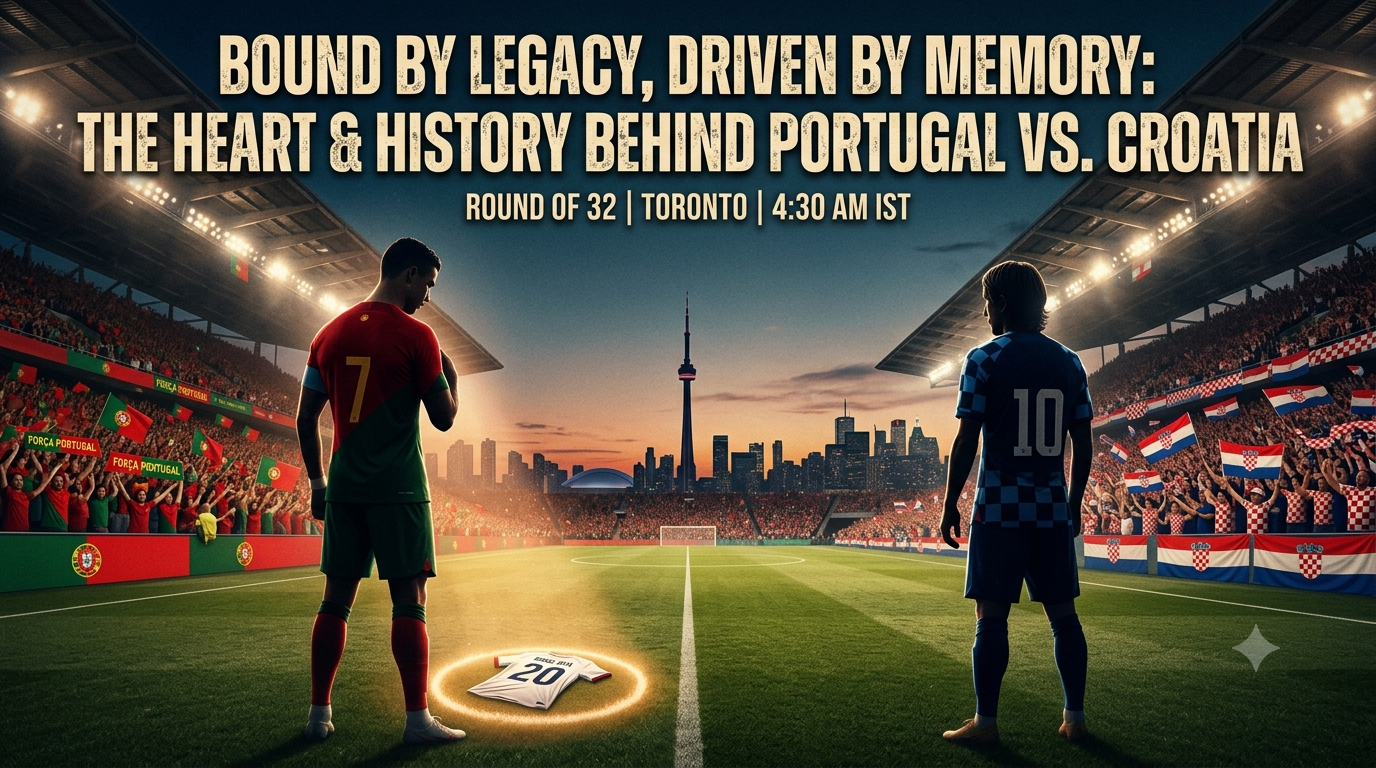
The FIFA World Cup Round of 32 knockout match between Portugal and Croatia brings together two European heavy weights under the lights in Toronto. Scheduled for a 4:30 AM IST kickoff, this encounter represents far more than a battle for a place in the round of 16. It is a collision of contrasting styles, a meeting of iconic legends facing the end of their international careers, and a deeply emotional milestone for a nation playing with a heavy heart.
When both squads step out on the pitch, tactical preparations will meet raw human emotion. While fans in India wake up in the early hours of the morning to watch, the players will carry the expectations of their nations alongside deeply personal motivations. For Portugal, the timing of this match brings a profound emotional layer, while Croatia looks to prove once again that their golden generation can defy the odds when the stakes are highest.
Head-to-Head: A Historic Portugal Edge
Historically, this fixture has favored the Seleção. Over their previous 10 international meetings across all competitions, Portugal has established clear psychological superiority. Looking closely at the numbers provides clear context for how these matches usually play out:
- Portugal Victories: 7
- Croatia Victories: 1
- Drawn Matches: 2
- Total Goals Scored: Portugal 19, Croatia 8
The lone victory for Croatia in this matchup came in a friendly encounter, meaning they have never defeated Portugal in a competitive, high-stakes tournament match. Their most recent encounter took place in November 2024 during the UEFA Nations League group stage, resulting in a hard-fought 1-1 draw. In that game, João Félix opened the scoring for Portugal before defensive standout Joško Gvardiol found an equalizer for Croatia. This lopsided historical record gives Portugal confidence, yet knockout football at a World Cup frequently disregards past statistics.
Group Stage Form and Path to the Knockouts
Neither team had a perfectly smooth journey through the group phase, as both sides dropped points and finished second in their respective standings. This creates an unpredictable dynamic for the knockout stage, with both managers still searching for their absolute best starting combinations.
Portugal showed defensive resilience throughout the group stage, conceding just a single goal across 270 minutes of play. Their attack exploded in a 5-0 victory over Uzbekistan but remained quiet in stalemates against DR Congo and Colombia.
Croatia, conversely, endured a rocky start by conceding four goals against England. They recovered well, displaying their trademark tournament grit to secure narrow, must-win victories against Panama and Ghana to guarantee progress.
The Twilight of Two Icons: Cristiano Ronaldo vs. Luka Modrić
The central narrative capturing global attention is the inevitable finality facing two legendary figures of 21st-century football. Cristiano Ronaldo, now 41, and Luka Modrić, at 40, are competing in what is certain to be their final World Cup tournament. Because this is a single-elimination knockout match, the reality is unyielding: one of these icons will see their World Cup career end permanently in Toronto.
Ronaldo and Modrić share a deep history, having spent years together at Real Madrid winning multiple UEFA Champions League trophies. They know each other’s games perfectly. For Modrić, the objective is to control the tempo from midfield, slowing down the pace to mask his physical decline while using his elite vision to create chances. For Ronaldo, his role has shifted from a dynamic winger to an absolute penalty-box predator, relying on positioning, movement, and clinical finishing.
The emotional weight of this match will filter down to every teammate on the pitch. No one in the Portuguese dressing room wants to be part of the squad that saw Ronaldo’s final World Cup dream end prematurely. Similarly, the Croatian players feel an intense loyalty to Modrić, wanting to extend his international career for at least one more match. This shared desperation ensures that individual battles will be contested with immense intensity.
Playing for Number 20: The Diogo Jota Anniversary
While the global audience focuses on the tactical and historical elements, the Portuguese camp is driven by a deep, heartbreaking motivation. The kickoff in Toronto takes place on the exact one-year anniversary of the tragic passing of forward Diogo Jota. On July 3, 2025, the football world was devastated when Jota and his brother, André Silva, lost their lives in a high-speed car accident in Zamora, Spain, just two weeks after Jota had helped his country win the UEFA Nations League title.
The tragedy left a permanent mark on this generation of Portuguese players. Manager Roberto Martínez spoke openly before the match, stating that Jota remains a constant presence in their thoughts, calling him “our light” and affirming that the squad intends to win this match directly in his memory. The team has kept Jota’s memory visible through several symbolic actions during their stay in North America:
- Every member of the squad wears a special wristband bearing Jota’s name, a gift from Portuguese Prime Minister Luís Montenegro.
- Midfielder Rúben Neves is wearing the number 21 jersey as a tribute.
- Jota’s parents, Isabel and Joaquim Silva, have been present in the stands during this tournament, visibly moved by the ongoing tributes.
As the match progresses past midnight back in Portugal, the anniversary becomes official. This emotional catalyst could prove to be a powerful unifying force for the Seleção, giving them an extra layer of resolve when fatigue sets in.
Tactical Breakdowns and Key Battlefield Areas
Roberto Martínez prefers a flexible system, often shifting between a 4-2-3-1 and a three-back system depending on the phase of play. His approach depends heavily on generating width through fullbacks João Cancelo and Nuno Mendes. By pushing these wide defenders high up the pitch, Portugal attempts to pin opponents back and create space for Bruno Fernandes to operate in central spaces.
Croatia coach Zlatko Dalić relies on a more compact, central approach. The veteran midfield trio of Modrić, Mateo Kovačić, and Luka Sučić remains the heart of the team. Their primary task will be to disrupt Portugal’s passing lanes and prevent Bruno Fernandes from finding Ronaldo in advanced positions. If Croatia can control possession in the center circle, they can neutralize Portugal’s speed on the counter-attack.
Another critical factor is squad depth. Portugal holds a clear advantage when looking at the options available on the bench. If the match remains tied late into the second half, Martínez can call upon attacking weapons such as Rafael Leão, Bernardo Silva, or Gonçalo Ramos to shift the momentum. Croatia lacks that same level of elite attacking depth, meaning they will rely heavily on the youthful energy of 23-year-old Martin Baturina to provide spark and ball-carrying ability against a disciplined Portuguese defense led by Rúben Dias.
Predicted Lineups
Both managers are expected to field their strongest possible lineups given the knockout nature of the fixture.

Final Match Verdict
This knockout clash promises to be a tight, cagey affair decided by minimal margins. Croatia will try to drag the match into extra time, relying on their historical excellence in penalty shootouts and longer matches. Still, Portugal’s defensive stability, paired with their superior bench options, makes them the slight favorites.
Combined with the powerful emotional motivation of honoring Diogo Jota’s memory on this difficult anniversary, the Seleção should find the necessary breakthrough to advance to the quarter-finals, bringing a legendary World Cup chapter to a close for Luka Modrić.
Leave a Reply