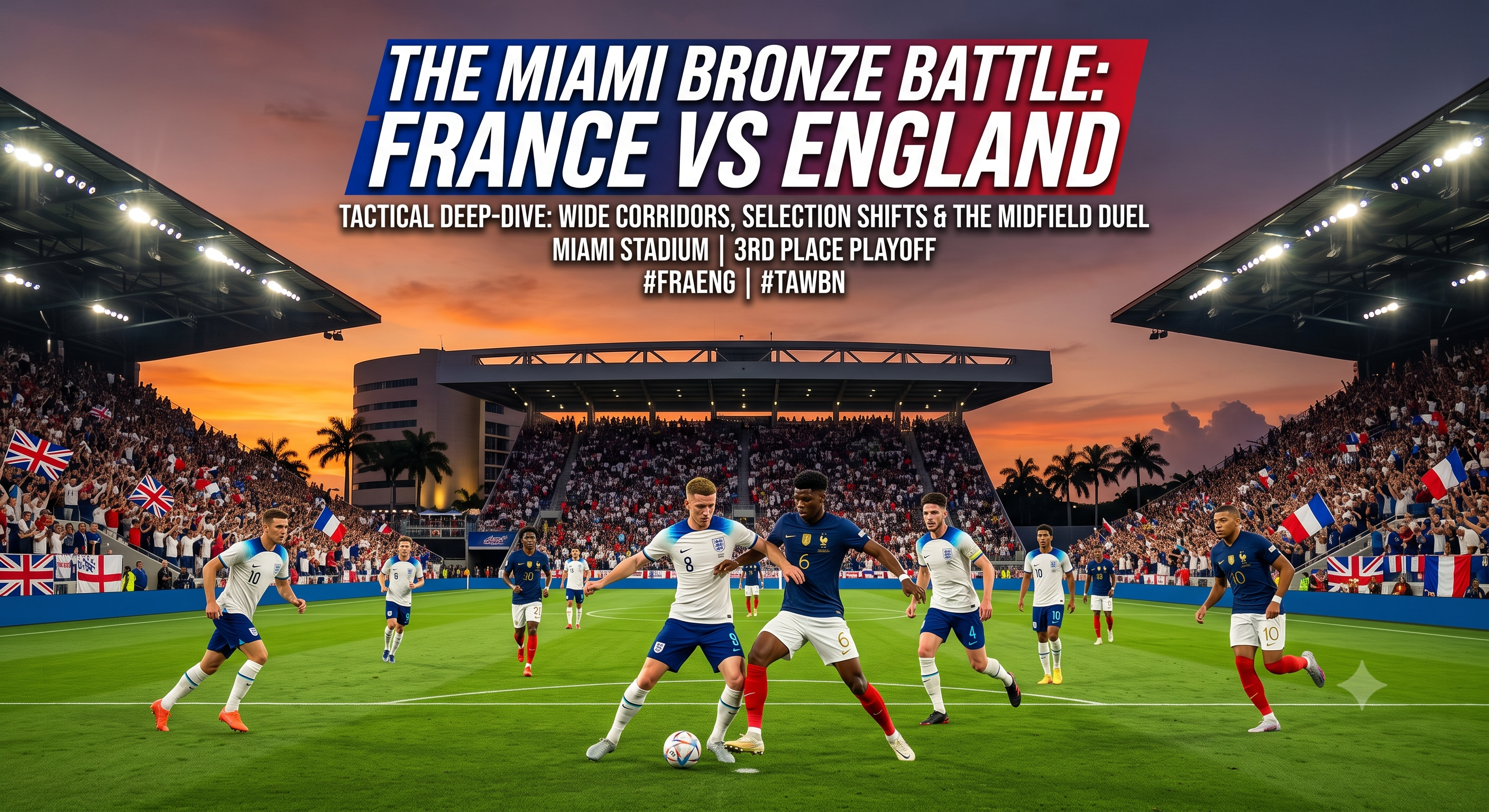
Let’s be completely honest before we open up our tactical notebooks. The third-place playoff (France vs England) is famously the fixture that no squad wants to play. After spending weeks grinding through high-stress knockout rounds, falling just short of the showpiece match leaves a unique kind of emotional weariness. Thomas Tuchel admitted his squad wanted to be preparing for the final instead of packing their bags for Florida.
For us analysts and football purists, this matchup inside Miami Stadium is a massive tactical gift. When the suffocating pressure of winning the ultimate trophy disappears, something fascinating happens to the systems on the pitch. Defensive blocks expand, managers loosen their strict tracking parameters, and we usually get a high-scoring, open game driven by individual pride and distinct personnel choices.
Let’s pull apart the structural machinery, the corrected wide corridor systems, and the individual subplots that will decide who takes home the tournament bronze.
The Deschamps Farewell and Forced Lineup Adjustments
This fixture marks the closing page of a legendary chapter in modern football history. Didier Deschamps is stepping down from his post after this final whistle blows, wrapping up a historic tenure as the leader of the French national team. His players know this, and that emotional undercurrent will play a massive role in how France approaches the opening half-hour.
Deschamps is dealing with severe physical stress in his center-back position. William Saliba was forced off in the 29th minute against Spain, thrusting Maxence Lacroix into the fire.
France’s Expected Tactical Base Shape
Deschamps will likely stick to his preferred 4-2-3-1 arrangement, but with fresh defensive faces:
- Goalkeeper: Mike Maignan
- Defensive Line: Malo Gusto, Ibrahima Konaté, Maxence Lacroix, Theo Hernández
- Midfield Screen: Warren Zaïre-Emery, Aurélien Tchouaméni
- Attacking Midfield: Michael Olise, Rayan Cherki, Bradley Barcola
- Forward Outlet: Kylian Mbappé
By introducing Maxence Lacroix from the start alongside Ibrahima Konaté, France hopes to match England’s aerial power. Malo Gusto is slated to take over the right flank, adding a highly dynamic overlapping asset who can pull England’s left-sided coverage completely out of position.
With creative options like Rayan Cherki and Désiré Doué ready to rotate into the advanced slots, Deschamps is setting up a team built to play with high lateral passing speed. This setup allows France to abandon the rigid low block and instead hunt for early turnovers in the middle third.
Attacking Corridor Spacing and the Golden Boot Chase
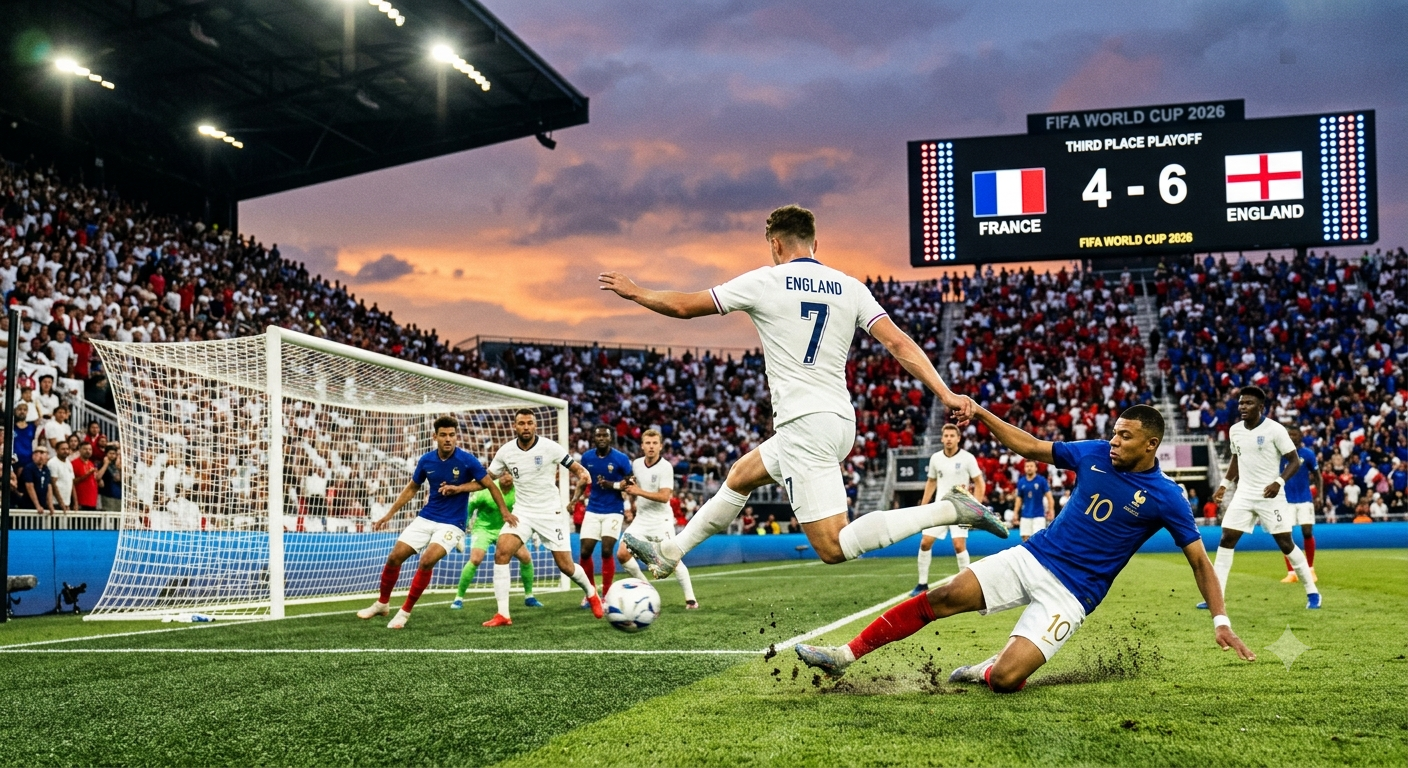
The main tactical focus for France will center on isolating their captain out wide. Kylian Mbappé enters the Miami turf sitting at 8 tournament goals, locked in a tight statistical tie with Argentina’s leading forward at the top of the goal-scoring charts. The individual prize is a powerful motivator, and the French distribution lines will look to feed him constantly.
Deschamps will space his wide corridors to create constant 1v1 situations. Michael Olise will occupy the right touchline, drawing the attention of England’s tracking defenders. This horizontal stretching opens up massive diagonal passing lanes for Warren Zaïre-Emery to hit quick switches directly into the path of Mbappé on the opposite wing.
If England’s defensive line fails to step up and close these passing lines early, Mbappé will exploit the space behind the full-backs with ease, driving direct shot opportunities into the bottom corners.
Tuchel’s Midfield Screen and the Anderson Factor
Tuchel is facing his own set of structural questions after the late defensive fracture against Argentina. The primary tactical problem in that semifinal loss was the way England’s midfield double pivot dropped too deep during the final ten minutes, completely surrendering territory on the edge of the area.
England’s Tactical Rest-Defense Shield in Midfield
To prevent a repeat collapse, England must sustain their advanced line parameters:
- Goalkeeper: Jordan Pickford
- Defensive Line: Reece James, John Stones, Marc Guéhi, Djed Spence
- Midfield Double Pivot: Elliot Anderson, Declan Rice
- Attacking Trio: Morgan Rogers, Jude Bellingham, Anthony Gordon
- Striker: Harry Kane
Declan Rice must maintain a high positioning line right in front of the central defenders. Rice cannot afford to turn into a temporary third center-back in Miami. His job is to squeeze the central pockets, preventing Rayan Cherki from turning comfortably when collecting second balls.
Partnered with Elliot Anderson, who has quietly anchored the hard yards in the engine room, the goal will be to restrict France’s vertical entry lanes into Zone 14. Anderson’s capacity to win physical duels will grant Rice the freedom to step up and intercept loose passes before they turn into dangerous French breaks.
The Bellingham Variable and Late Box Entries
England’s main offensive threat will come from how Jude Bellingham responds to Aurélien Tchouaméni’s tracking parameters. Bellingham has logged 6 tournament goals, matching the output of Harry Kane. His ability to time his forward runs from deep midfield positions makes him incredibly difficult to mark in open play.
When Kane drops deep into the half-space to collect the ball, he will naturally drag Ibrahima Konaté or Lacroix out of alignment. This movement generates a brief spatial vacuum in the heart of the French penalty box.
Bellingham’s primary assignment is to read that movement and trigger direct vertical sprints into the open gap. If Tchouaméni fails to maintain a tight cover-shadow, Bellingham will find himself completely unmarked at the end of crosses delivered by Morgan Rogers and Anthony Gordon.
The Second-Half Volume and Bench Parameters
Because both groups are carrying immense physical fatigue, the match will completely transform after the 60-minute mark. Tuchel and Deschamps will rely heavily on their bench choices to preserve structural balance.
For England, look for Morgan Rogers and Anthony Gordon to exert high physical pressure on the French full-backs early on. When their energy curves drop, Tuchel has elite horizontal depth with Bukayo Saka and Marcus Rashford waiting to exploit tired tracking lines.
France will answer that depth by utilizing the rapid lateral pacing of Désiré Doué and Marcus Thuram in the final half-hour, setting up a pure battle of structural endurance.
Performance Indicators for the Bronze Playoff
To accurately map out how this match will unfold across the 90 minutes, we need to monitor three explicit indicators:
- Flank Tracking Speed: How well Reece James and Djed Spence manage their recovery runs against Mbappé and Olise will dictate England’s defensive safety.
- Turnover Locations: Committing unforced errors inside the center circle will allow France to launch rapid vertical counter-attacks before the English backline can adjust their spacing.
- Set-Piece Isolation: With open-field lines expanded, rehearsed dead-ball routines provide the cleanest method to build a scoreline cushion without exposing the rest-defense layout to counter-attacks.
Over to You: Will France’s wide corridor combinations successfully lock down the individual goal-scoring crown for Kylian Mbappé, or will Thomas Tuchel’s English lineup find the defensive discipline required to break their historic bronze playoff jinx? Drop your precise tactical breakdowns and technical notes in the comments below!
Leave a Reply