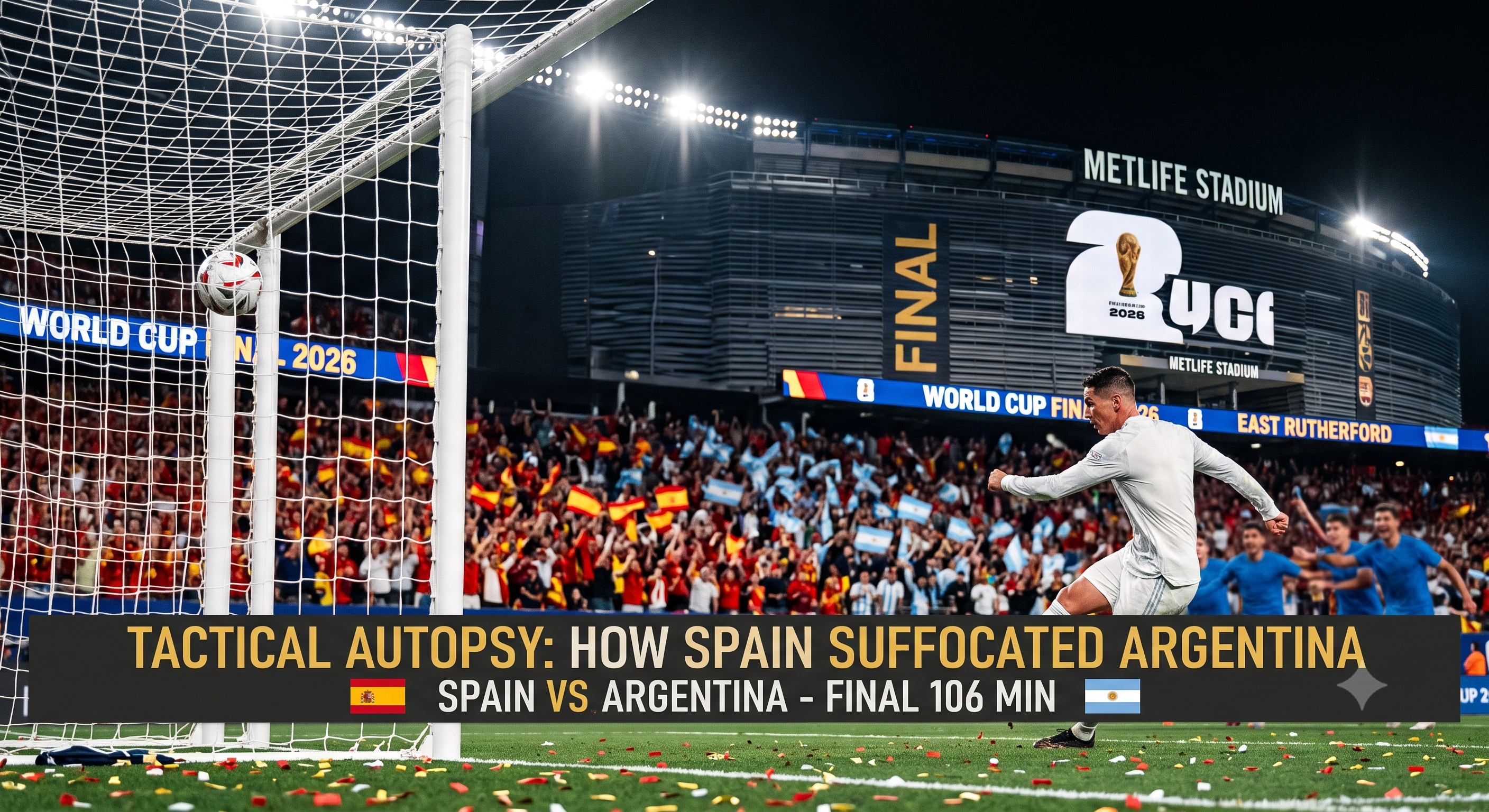
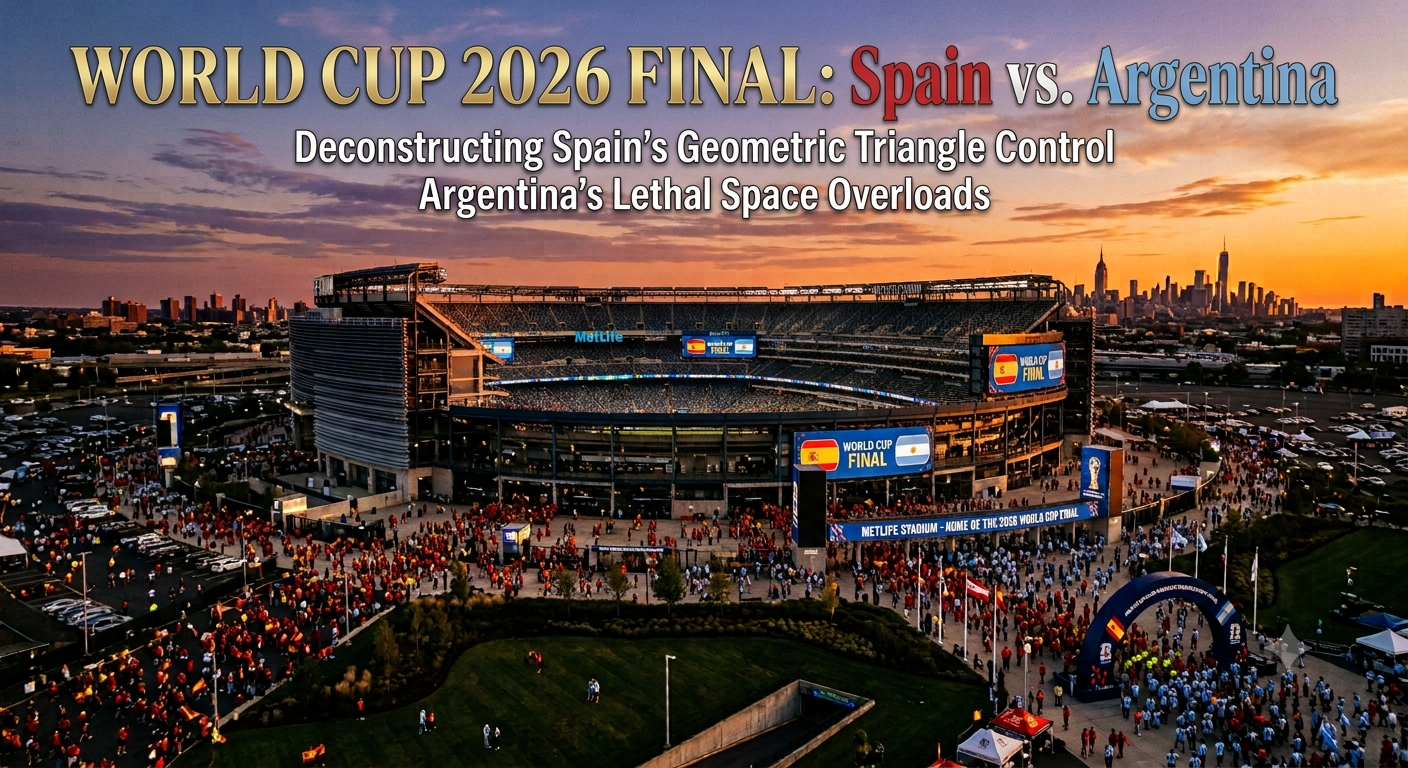
The FIFA World Cup 2026 final delivered a masterclass in modern positional play as Spain dethroned Argentina with a thrilling 1-0 victory after extra time. At New York New Jersey Stadium, 120 minutes of intense action culminated in Ferran Torres striking the decisive goal in the 106th minute.
For fans analyzing the Spain vs Argentina tactical showdown, the match offered a detailed look at structural dominance, pressing traps, and squad depth. Below is the technical breakdown of how Luis de la Fuente’s side dismantled Lionel Scaloni’s setup to lift the global trophy.
The Possession Trap: Spain vs Argentina First-Half Tactics
Neutralizing Argentina’s Central Axis
Spain set an immediate tempo, controlling the ball and establishing positional superiority in the central third. Operating in a fluid 4-1-2-3 formation, Spain used Rodri as a single anchor, allowing Fabián Ruiz and Álex Baena to push higher into the half-spaces. This shape formed a numerical overload against Argentina’s two-man central pairing of Rodrigo De Paul and Enzo Fernández.
Argentina set up in a compact 4-4-2 block, opting to protect the center of the pitch. Lionel Scaloni instructed his midfield lines to sit deep, denying space behind the defense. This strategy limited direct box entries early on, but forced Argentina into extended defensive spells.
During the opening 45 minutes of the FIFA World Cup 2026 final, Spain generated significant territorial dominance:
- Possession Share: Spain 64% – 36% Argentina
- Pass Completion: Spain 91% – Argentina 82%
- Final Third Entries: Spain 28 – 9 Argentina
Testing Emiliano Martínez in the World Cup Final
Despite sitting in a low defensive block, Argentina conceded four shots on target before the halftime whistle. Lamine Yamal operated wide on the right flank, repeatedly isolation-testing Nicolás Tagliafico. In the 24th minute, Yamal cut inward and forced a low diving save from Emiliano Martínez. Ten minutes later, Dani Olmo tested the Argentine keeper with a curling effort from 22 yards out.
Argentina struggled to launch quick transitions. Lionel Messi and Julián Alvarez were isolated up front, receiving limited service as Spain’s counter-pressing restored immediate possession.
FIFA World Cup 2026 Final Midfield Warfare: Scaloni’s Adjustments
The Second-Half Defensive Wall
Recognizing the central overload, Scaloni made a tactical modification at halftime. Nicolás González was replaced by Leandro Paredes in the 45th minute, shifting Argentina into a firmer 4-3-1-2 shape. Paredes slotted directly alongside Fernández, while De Paul covered the right side to assist Gonzalo Montiel against Spain’s left-sided attacks.
The shift reduced Spain’s passing lanes through the middle. Spain continued to probe the perimeter, but Argentina’s central defensive pairing of Cristian Romero and Lisandro Martínez blocked multiple efforts inside the penalty box.
Physical Intensity and Disciplined Foul Management
As space grew scarce, the physical battles intensified. Argentina relied heavily on tactical fouls to disrupt Spain’s passing rhythm in the middle third. Lisandro Martínez picked up a booking in the 41st minute, followed by Leandro Paredes in the 52nd minute.
Spain stayed calm under pressure, maintaining structural discipline and avoiding yellow cards throughout regular time. De la Fuente adjusted his attack in the 61st minute by replacing Mikel Oyarzabal and Fabián Ruiz with Ferran Torres and Pedri. The fresh legs maintained Spain’s high pressing intensity, keeping Argentina pinned inside their own half.
Red Card Turning Point in Extra Time: Spain vs Argentina
The Enzo Fernández Dismissal
The defining tactical turning point in this Spain vs Argentina epic occurred deep in second-half stoppage time. In the 90+3 minute, Enzo Fernández committed a late challenge on Spanish central defender Pau Cubarsí. Having already been booked in the 82nd minute, Fernández received his second yellow card, resulting in a red card ejection.
Playing with ten men forced Argentina into a complete defensive retreat for extra time. Scaloni substituted Julián Álvarez for defender Marcos Senesi in the 101st minute, leaving Messi as a lone forward.
The Disallowed Goal and Persistent Pressure
Spain capitalized on the numerical advantage immediately, pinning Argentina against their own penalty box. In the 98th minute, De la Fuente brought on Martín Zubimendi for Rodri and Eric García for Aymeric Laporte to keep energy levels high.
Shortly after, Nico Williams thought he had broken the deadlock following a scramble in front of Martínez. However, a VAR review revealed a foul by Mikel Merino on Nicolás Otamendi during the build-up phase, canceling out the goal. Spain maintained relentless pressure into the second period of extra time.
Ferran Torres Scores the Winning Goal in the 2026 World Cup Final
Deconstructing the 106th-Minute Breakthrough
Just 37 seconds into the second period of extra time, Spain’s tactical persistence bore fruit. Right-back Pedro Porro advanced high up the flank, taking advantage of Argentina’s narrow ten-man shape.
Porro delivered a precise, deep cross toward the back post. Substitute winger Nico Williams out-leaped Nahuel Molina, heading the ball back across the face of the six-yard box. Ferran Torres anticipated the movement, breaking away from his marker to volley the ball past Emiliano Martínez into the roof of the net.
The Tactical Metrics of the Winning Sequence
- Passes in Build-up: 14 consecutive passes before Porro’s cross
- Box Entries in Extra Time: Spain 11 – 1 Argentina
- Torres Efficiency: 2 shots, 1 goal, 100% conversion rate inside the box
Torres nearly doubled the lead minutes later after latching onto a through-ball from Lamine Yamal, but the assistant referee correctly flagged him offside. Argentina pushed forward out of desperation during the final five minutes, bringing up keeper Martínez for a late corner kick, but Unai Simón safely gathered the ball to seal victory.
Statistical Breakdown: Spain vs Argentina World Cup Final Autopsy
When analyzing the entire 120-minute contest, the final numbers highlight Spain’s sustained control over every phase of play:
| Match Parameter | Spain | Argentina |
| Final Score | 1 | 0 |
| Possession | 62% | 38% |
| Total Shots | 19 | 5 |
| Shots on Target | 8 | 1 |
| Expected Goals (xG) | 2.28 | 0.48 |
| Corner Kicks | 9 | 2 |
| Completed Passes | 784 | 412 |
| Pass Accuracy | 89% | 80% |
| Fouls Committed | 11 | 21 |
| Yellow Cards | 0 | 6 |
| Red Cards | 0 | 1 |
Key Tactical Indicators
- Flank Overloads: Spain generated 68% of their attacks through wide corridors, using Pedro Porro and Marc Cucurella to stretch Argentina’s narrow midfield bank.
- Counter-Pressing Speed: Spain recovered possession within 5 seconds of losing it on 19 separate occasions, preventing Argentina from initiating effective counter-attacks.
- Depth Quality: De la Fuente’s substitutions directly generated the winning moment, with substitutes Pedro Porro, Nico Williams, and Ferran Torres combining for the 106th-minute goal.
Spain’s victory at New York New Jersey Stadium caps off an extraordinary campaign defined by structural dominance, tactical adaptability, and squad depth. By neutralizing Argentina’s central playmakers and capitalizing on the extra-time numerical advantage, Luis de la Fuente’s squad officially earned the crown in this historic FIFA World Cup 2026 final.

Leave a Reply