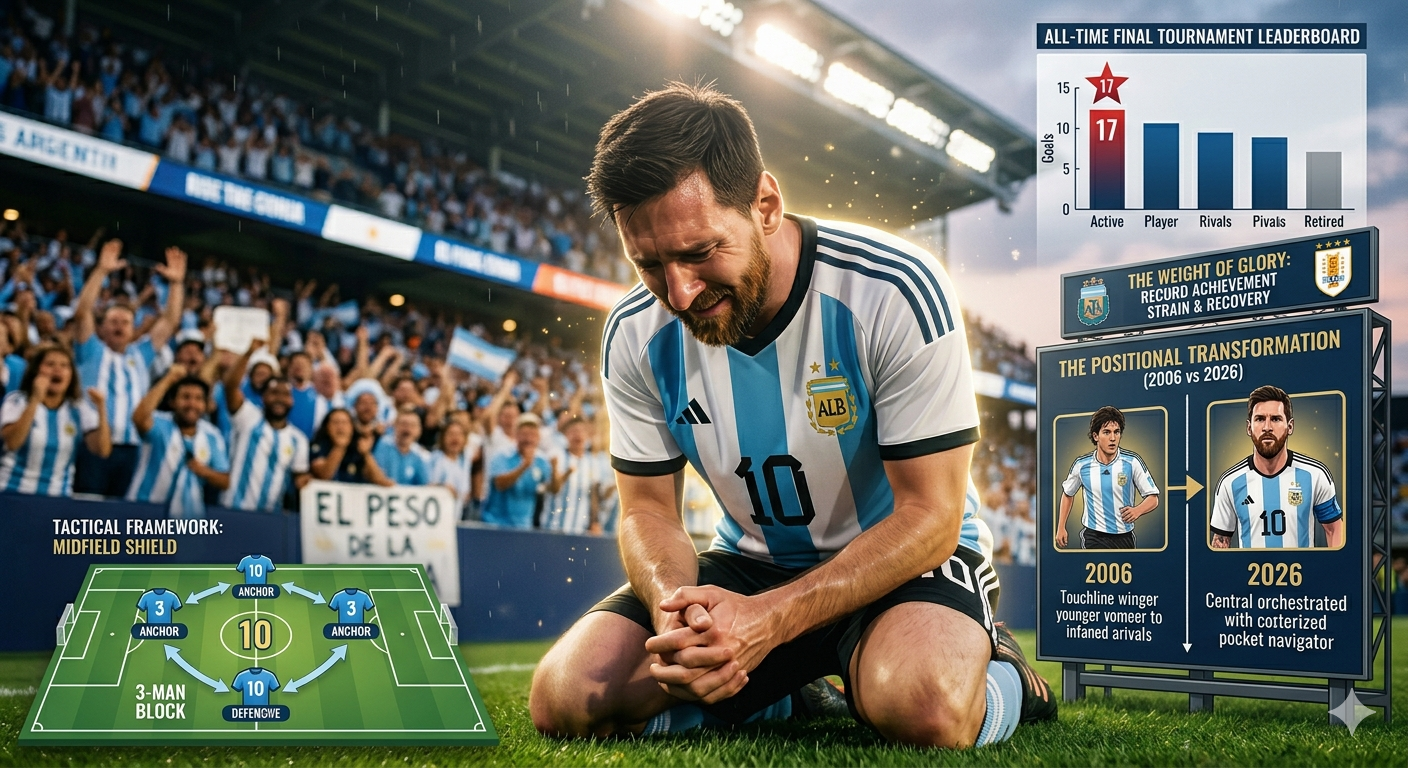
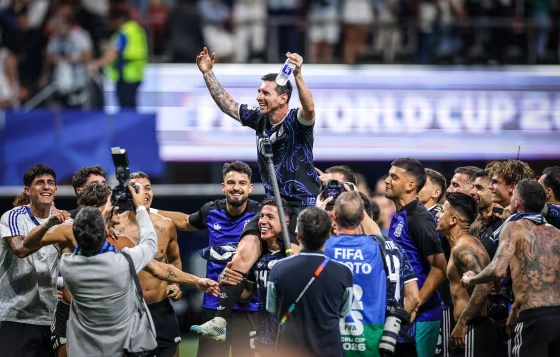
History was rewritten in Arlington, Texas, as the footballing world witnessed the modification of a legendary sporting baseline. During Argentina’s high-stakes Group J clash against Austria, Lionel Messi struck a definitive blow to claim the outright record as the highest goalscorer in men’s World Cup history. By registering his 17th career goal on the global stage, the Argentine captain broke Miroslav Klose’s long-standing mark of 16, adding another historic milestone just days before his 39th birthday.
While mainstream sports coverage will focus entirely on the emotional celebration, serious observers must examine the structural choices that made this moment possible. The achievement was a masterclass in spatial awareness, technical resilience, and tactical longevity.
The Geometry of the 38th Minute
The record-breaking sequence offered a textbook demonstration of pocket-space exploitation. Facing an Austrian side deployed in an aggressive defensive structure, Argentina focused on drawing the opposition’s midfield screen out of alignment.

- The Deep Baiting Phase: As Argentina circulated the ball across their backline, deep midfield anchors dropped lower to pull Austria’s pressing lines forward. This movement stretched the vertical distance between Austria’s midfield and their defensive line.
- The Half-Space Entry: With the central corridors elongated, a crisp vertical pass bypassed the midfield cover-shadow. Messi occupied this vacant pocket on the edge of the area, receiving the ball completely free of immediate tracking pressure.
- The Execution: Moving with technical fluid precision, the maestro set his sights and unleashed a trademark left-footed, curling effort that bypassed the outstretched keeper to nestle into the corner.
This moment of technical perfection was made even more impressive by the psychological recovery that preceded it. Just 28 minutes earlier, Messi dragged a 10th-minute penalty wide of the post. To overcome a high-stress setback early in a decisive match highlights the intense focus that defines elite competitors.
Closing the Deal: Stoppage-Time Insurance
While the narrative arc of the match was dominated by the record-breaking moment, the final scoreline required a complete tactical wrap-up. Austria remained dangerously active, throwing physical vertical pressure against the South American backline.
- The Structural Shield: Head coach Lionel Scaloni introduced fresh defensive layers late in the second half, solidifying a strict counter-pressing shape that restricted Austria’s late aerial deliveries.
- The Fast Break: In the 95th minute, with Austria committing numbers forward to chase an equalizer, Argentina triggered a rapid transition sequence. Julián Álvarez locked onto a loose ball, executing a sharp, vertical sequence with Messi.
- The Final Blow: Slipping into the left side of the six-yard box on a fast break, Messi collected the ball and slotted home a clinical left-footed finish to secure a 2-0 scoreline. This second strike not only sealed the victory but extended his newly minted global benchmark to 18 goals, guaranteeing Argentina’s direct passage into the knockout rounds.
A Twenty-Year Timeline of Tactical Evolution
Surpassing Klose’s benchmark is a triumph of longevity. Messi became the first male footballer to find the back of the net across six distinct tournament editions, stretching from 2006 to 2026. This two-decade timeline tracks a complete transformation in his physical and positional deployment.
In 2006, a teenage asset operated on the wide touchlines, relying on explosive acceleration to unbalance fullbacks. In 2026, the older forward dictates play through spatial economy, navigating central channels and using his teammates’ movement to decongest shooting angles. Registering 5 goals in just 2 matches during this campaign proves that his adjusted style remains incredibly efficient against modern defensive lines.
Structural Triumph Over Strain
The achievement carries immense emotional weight when viewed alongside the personal and physical hurdles limiting his preparation. Reports surrounding the team camp noted that the captain entered the match under significant personal stress, keeping a close eye on his father’s ongoing health recovery back home.

Furthermore, a persistent hamstring issue had restricted his training volume leading up to Matchday 2. Lionel Scaloni’s structural system adjusted to preserve his talisman, setting up a solid three-man midfield block that handled defensive tracking duties. This tactical shield allowed Messi to focus entirely on final-third positioning, proving that smart team design can maximize the impact of an experienced asset even under physical and personal strain.
The All-Time Final Tournament Leaderboard
To frame this historic shift, the updated leaderboard showcases the most efficient goalscorers in men’s final tournament history:
| Player | Goals | Matches | Tournament Span | Active Status |
| Lionel Messi (ARG) | 17* | 28 | 2006 – 2026* | Active |
| Miroslav Klose (GER) | 16 | 24 | 2002 – 2014 | Retired |
| Ronaldo (BRA) | 15 | 19 | 1994 – 2006 | Retired |
| Gerd Müller (FRG) | 14 | 13 | 1970 – 1974 | Retired |
| Kylian Mbappé (FRA) | 14* | 14 | 2018 – 2026* | Active |
| Just Fontaine (FRA) | 13 | 6 | 1958 | Retired |
| Pelé (BRA) | 12 | 14 | 1958 – 1970 | Retired |
NOTE: The asterisk (*) is there to inform you that the player is still actively playing and can score again. (Updated: 12:08 AM IST)
With Argentina occupying an advantageous seeding path, Messi has ample opportunity to extend his 18-goal record even further, raising the bar for future generations.
Over to You: Did Lionel Scaloni’s decision to build a protective midfield shield provide the perfect structural framework for Messi to recover from his early penalty miss, or did Austria’s backline simply suffer a terminal tracking breakdown on the edge of the area? Drop your deep tactical notes in the comments below!
Leave a Reply