
If you turned off the television in the 84th minute believing that England was about to break a 60-year curse and secure a spot in the final, nobody would blame you. Thomas Tuchel’s side had one hand on the ticket to New York.
What unfolded next wasn’t just a loss; it was a pure lesson in how quickly structural control can dissolve under the ultimate late-game pressure. A brutal seven-minute defensive collapse turned a historic night into an absolute nightmare, sending defending champions Argentina through to the grand finale with a breathless 2-1 victory.
As an analyst tracking every movement on this pitch, I saw a match entirely defined by the fine margin between structured low-block execution and elite, chaotic tactical shifts. Let’s break down exactly how England’s defensive layout fractured under Argentina’s late-game heat.
The Tactical Plan and Gordon’s Spark
For the opening 55 minutes, Tuchel looked like an absolute genius. His decision to overhaul the full-backs yet again by introducing Djed Spence and Reece James completely locked down Argentina’s wide options early on. The game began at an intensely physical, stop-start tempo, with both teams trading heavy challenges rather than elegant passing sequences.
The plan bore fruit ten minutes into the second half. Morgan Rogers found space on the break, driving down the flank before curling a brilliant cross across the face of the six-yard box. Anthony Gordon, arriving with absolute intelligence at the back post, snuck directly in front of Nahuel Molina to control a beautiful finish past Emiliano Martínez. At 1-0, the stadium erupted. England had the momentum, the shape, and the dream within touching distance.
The Deep Drop and Pickford’s Resolute Shield
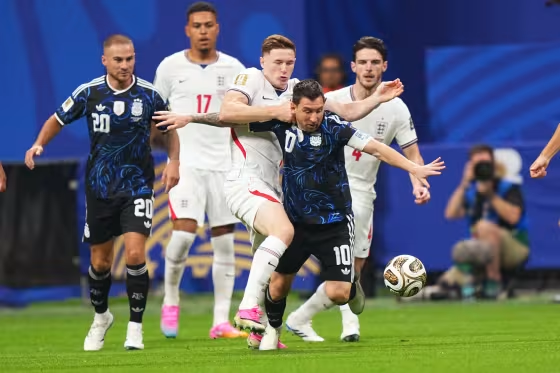
Then came the fatal mistake that football fans have seen all too often. Instead of maintaining an advanced rest-defense line to trap Argentina in their own half, England collectively decided to preserve what they had. They dropped way too deep. Harry Kane dropped into his own half, and the midfield double pivot essentially turned into an auxiliary back six.
When you give a team featuring Lionel Messi total territorial control, you are playing with fire. Lionel Scaloni smelled blood and adjusted his engine room layout, introducing Rodrigo De Paul, Nicolás González, and eventually Lautaro Martínez to stack bodies inside the final third. The only reason the English wall didn’t crumble sooner was Jordan Pickford.
In the 69th minute, Nico González met a sweeping cross with a powerful, goal-bound header. Pickford read the match geometry flawlessly, pulling off a breathtaking, full-stretch one-handed stop to push the ball away. Alexis Mac Allister hit the post shortly after, signaling that the pressure was at its most volatile.
Seven Minutes of Absolute Mayhem
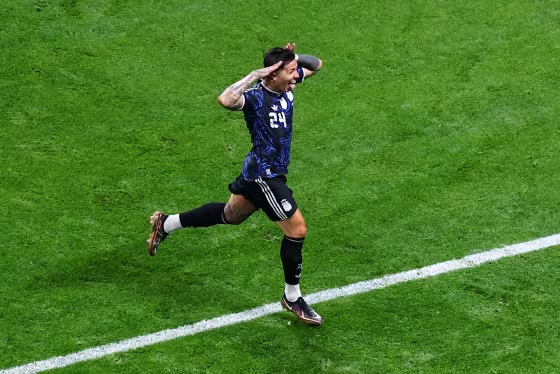
The structural dam finally burst in the 85th minute, and it started with a simple breakdown in midfield communication. Following a short-corner routine, England’s deep lines failed to step up and close down the space on the edge of the box. Messi spotted the gap, slipping a casual square pass into Enzo Fernández’s path.
With no white shirt tracking out to pressure the ball, Fernández unleashed a low launcher from distance that whistled past Pickford’s right hand. 1-1. With England visibly shell-shocked and struggling to adjust their spacing, Argentina kept their foot on the accelerator.
In the 92nd minute, the ultimate dagger was driven in. Messi picked up the ball in the half-space channel, drawing the eyes of three English markers. With a flick of his boot, he delivered a vintage, looping cross into the heart of the area.
England’s central defenders, exhausted from absorbing endless waves of vertical pressure, suffered a critical lapse in tracking. Substitute Lautaro Martínez snuck directly between Marc Guéhi and John Stones, rising highest to redirect a bullet header into the corner.
Midfield Fractures and the Substitution Dilemma
To fully comprehend the anatomical failure of England’s final ten minutes, we must examine the specific personal changes that completely altered the structural balancing act in the center circle. Up until the 80th minute, Declan Rice had carried out a monumental tracking assignment, effectively acting as the central plug to stop Messi from turning comfortably into Zone 14.
However, the physical stress curve took its toll. When Tuchel substituted Rice for Nico O’Reilly in the 82nd minute, the structural stability of the midfield double pivot experienced immediate placement friction. O’Reilly, lacking Rice’s elite positioning radar, dropped too close to his own center-backs, completely opening up the edge of the area.
This structural vacuum gave Enzo Fernández the brief pocket of time needed to look up, steady his stride, and unleash his regular strike. In high-stakes knockout football, altering your central defensive anchor past the 80th minute without establishing a clear cover-shadow is structural suicide.
Argentina’s Tactical Overload and Elite Mentality
While England collapsed structurally, immense credit must belong to Lionel Scaloni’s structural flexibility. Recognizing that his initial lopsided 4-4-2 arrangement was struggling to break down James and Spence out wide, the Argentine tactician implemented a complete attacking adjustment.
By taking off left-back Nicolás Tagliafico and introducing Lautaro Martínez in the 80th minute, Argentina abandoned all defensive caution to roll out an asymmetric, front-heavy shape. This forced Julian Alvarez to drift wider, pulling John Stones out of the central channel and leaving Marc Guéhi completely isolated against two direct aerial threats.
This specific overload directly generated the spacing mismatch for the 92nd-minute winner. When Messi delivered his looping cross, Stones was caught recovering from a wide corridor, leaving Lautaro completely unmarked inside the six-yard box. It was a masterclass in using substitute window volume to shatter a tiring low block.

Key Battle Indicators: Where the Semi-Final Was Settled
- Midfield Spacing Volatility: Substituting Declan Rice eliminated England’s primary counter-pressing screen, leaving Enzo Fernández completely unmarked on the edge of the area.
- The Messi Matrix: Even on an afternoon where his vertical dribbling lanes were thoroughly choked, the maestro stayed alert. His two match-winning assists proved that elite creators only need a split second to completely rewrite tournament history.
- The Depth Factor: Scaloni managed his bench assets perfectly, using Lautaro Martínez to apply relentless physical pressure against a highly fatigued English central defense.
Over to You: Did England’s late defeat prove that dropping into a passive low block against elite opposition is always a recipe for disaster, or was Argentina’s stunning comeback simply a testament to Lionel Messi’s inevitable genius under pressure? Drop your precise tactical notes and match metrics in the comments below!
Leave a Reply