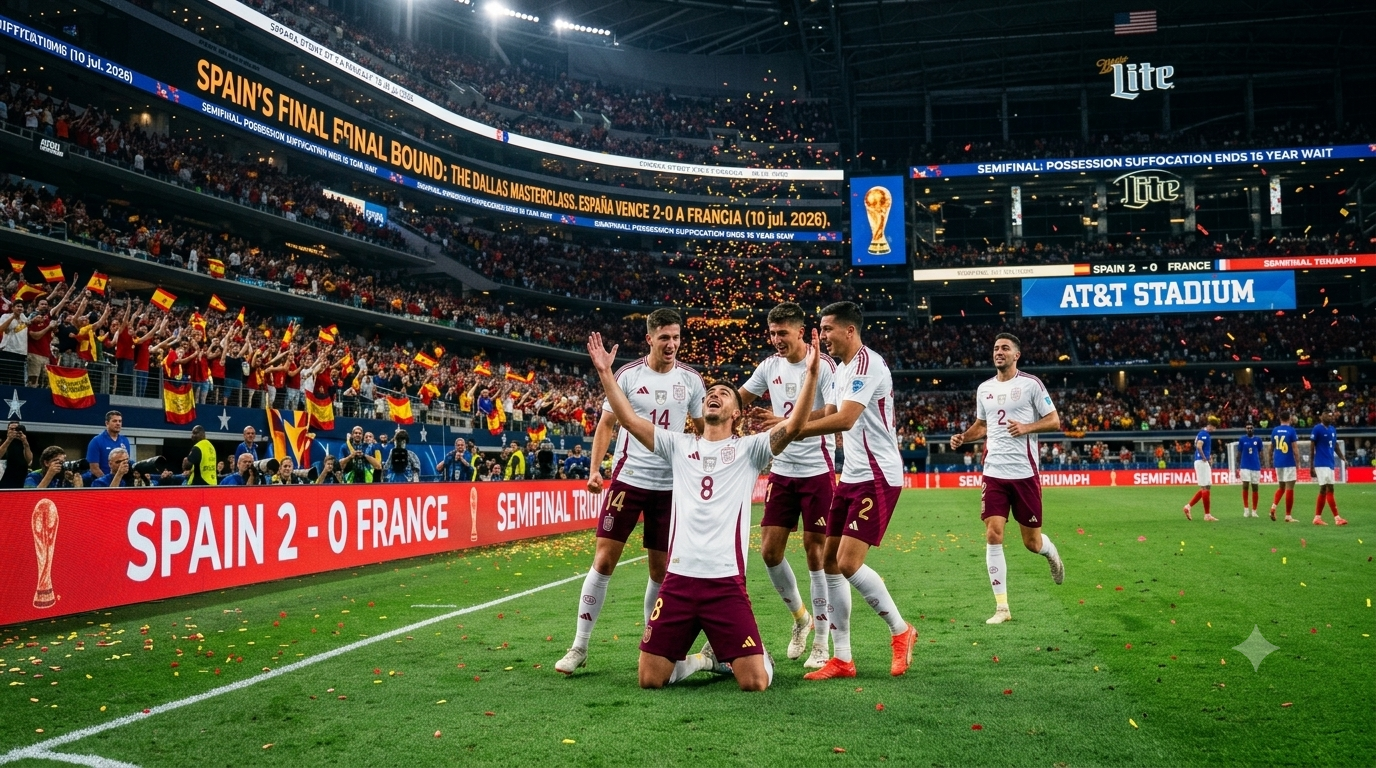
Pull up a chair, grab your notes, and let’s look at what just happened in Texas. If you watched the semifinal clash at Dallas Stadium expecting a wild, end-to-end chaotic battle, you probably walked away stunned. What we witnessed wasn’t just a win; it was a pure lesson in geometric control that shattered 16 long years of tournament waiting for Spanish football.

Luis de la Fuente’s side absolutely outclassed Didier Deschamps’ France 2-0 to book their ticket to the grand finale in New Jersey. They did it by using a weapon that feels completely second nature to them: total, rhythm-driven ball circulation that suffocated the life out of the star-studded French frontline. For the first time since the legendary night in Johannesburg back in 2010, Spain is back exactly where they believe they belong.
Let’s pull back the curtain on the actual tactical machinery and the individual key battles that decided this historic game.
Midfield Control and Rodri’s Center-Circle Authority
If you want to understand how this 16-year barrier was finally broken, look no further than the center circle. The defining duel of the afternoon pinned the French double pivot against Spain’s midfield anchor, Rodri. The Manchester City maestro delivered a performance that belonged in a textbook, dictating the tempo from the initial whistle to the final seconds.

France attempted to crowd the central channels with Aurélien Tchouaméni and Adrien Rabiot, trying to force unforced turnovers and spark their signature high-speed transitions. Rodri single-handedly dismantled that plan. He acted as a human shield, keeping the ball moving horizontally to tire France’s midfield lines and pull their narrow shape completely out of alignment.
With Spain stringing together short, technical pass combinations at a 91% team accuracy baseline, France spent long periods chasing shadows. Every time Les Bleus tried to press, Rodri simply recycled the ball, completely choking their counter-attacking pipelines before they could even form.
Unai Simón’s Outstanding Sweeping Clearances
When France did manage to find a rare lane to bypass the midfield, they ran directly into another tactical wall. Deschamps looked to exploit the space behind Spain’s high defensive line by using Michael Olise to feed direct long balls over the top for Kylian Mbappé and Bradley Barcola. This is where goalkeeper Unai Simón stepped up to save the day.

Instead of staying rooted to his line, Simón read the match geometry with spectacular focus. Three distinct times when Mbappé appeared ready to break free onto a vertical transition route, Simón anticipated the weight of the pass, raced out of his 18-yard box, and executed outstanding sweeping clearances to eliminate the danger.
His aggressive positioning acted as the ultimate safety net for center-backs Pau Cubarsí and Aymeric Laporte, allowing the backline to sustain their advanced territory tilt without fearing terminal long-ball penalties. By performing as an auxiliary sweeper-keeper, Simón ensured that France’s dangerous forwards remained entirely isolated from high-efficiency shot locations.
The Flank Battle: Yamal’s Threat and Oyarzabal’s Spot-Kick

Out wide, the matchup between Lamine Yamal and Lucas Digne tilted the landscape heavily in Spain’s favor. Yamal operated as a relentless isolation trigger along the right corridor, repeatedly forcing the French left-back into backward tracking recovery runs.
The pressure finally fractured the French defensive layout in the 22nd minute. Yamal used a quick change of pace to cut inside the area, baiting Digne into a mistimed, clumsy challenge that sent the winger down. The referee pointed straight to the spot.
Advanced forward Mikel Oyarzabal stepped up to execute the penalty, striking a clinical effort past Mike Maignan to log a well-deserved 1-0 advantage. The opening goal forced France to eventually expand their defensive layout, leaving wider gaps across the channels for Spain’s fullbacks to exploit.

Porro’s Tactical Inversion and Second-Half Suffocation
If you expected Spain to drop deep to protect their slim lead after the interval, you haven’t watched this team evolve. Rather than retreating into a passive low block, La Roja doubled down on their spatial overloads, leading to the definitive tactical blow in the 58th minute.
Right-back Pedro Porro triggered a brilliant vertical entry, exploiting a tracking delay in the French second line. Porro worked a rapid, sharp give-and-go with Dani Olmo, slicing straight through the heart of the defense before dispatching an expert finish into the bottom corner past Maignan.

At 2-0, the game was effectively sealed. De la Fuente managed the final half-hour like a chess master, using his substitute windows to introduce fresh wide tracking parameters. Mikel Merino, Pedri, and Nico Williams entered the pitch, maintaining absolute possession security and keeping the ball entirely out of danger zones until the final whistle blew.
The Core Tactical Conclusions
The analytical data from this historic semifinal confirms that control over the middle third remains the ultimate factor in elite tournament environments. Spain didn’t just outscore France; they completely took away their ability to play football on their own terms.
- Midfield Domination: By keeping pass completion high and winning the ball back quickly, Spain starved the French front three of necessary service.
- Sweeper Security: Simón’s proactive clearances neutralized the long-ball outlet, keeping the game played inside France’s half.
- The Unbeaten Run: Advancing with their 36-match unbeaten parameter intact gives this young squad immense psychological safety heading into the final hurdle.
- The 16-Year Bridge: Reaching the final with their 36-match unbeaten parameter intact connects this new generation directly with the legendary heroes of 2010.

Over to You: Did Spain’s absolute possession suffocation establish the definitive template for opening up heavy defensive shapes, or did France’s lackluster transition display show a total failure to adapt under pressure? Drop your precise tactical metrics and technical notes in the comments below!
Leave a Reply