
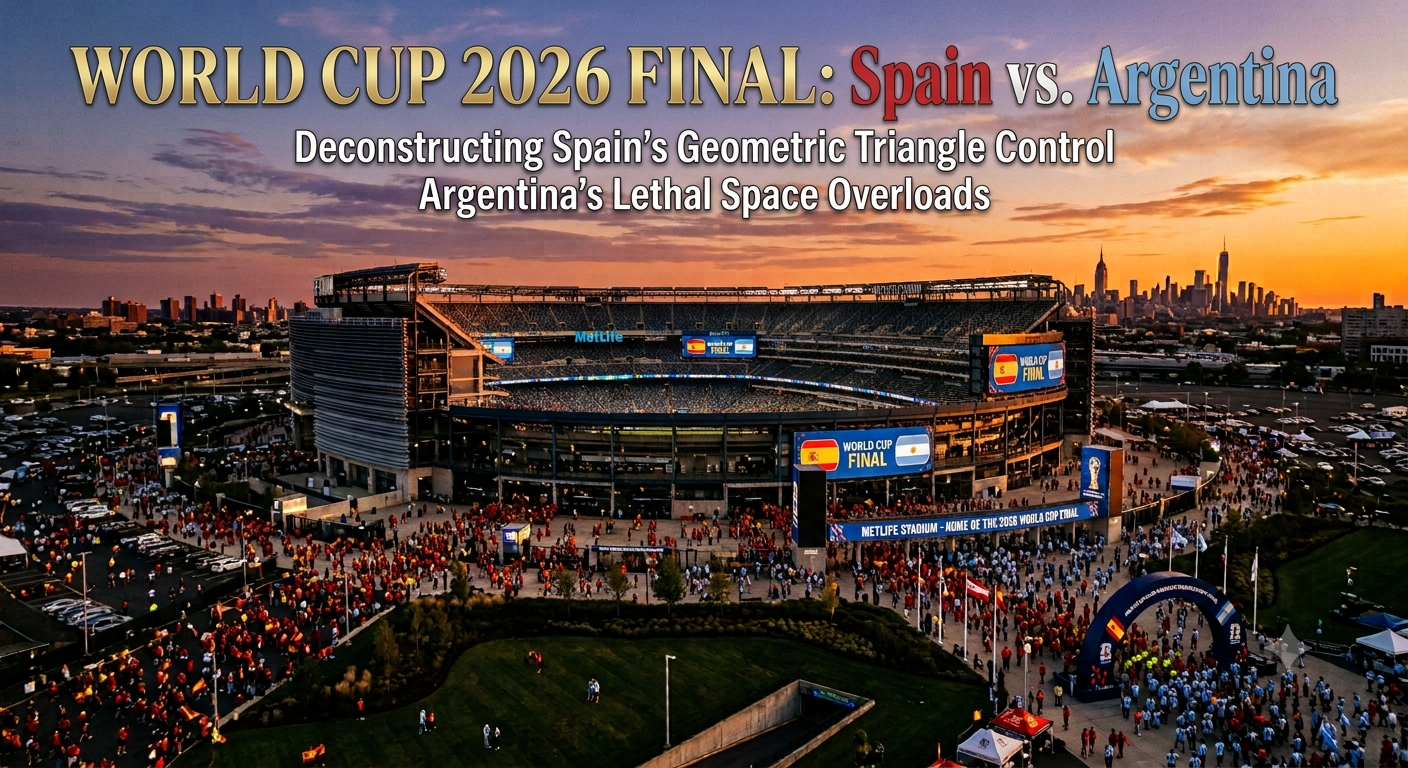
The structural sorting parameters of the global stage have converged to set up a true heavyweight block. The first semifinal fixture at Dallas Stadium isolates tactical pacing logic from raw counter-pressing speed, establishing a zero-margin framework where structural line adjustments determine single-elimination progression.
Didier Deschamps’ France and Luis de la Fuente’s Spain will collide in Texas, bringing distinct variations of territorial control to a match that serves as a highly anticipated rematch of their prior continental knockout battles. Backing up these observations with explicit performance indicators reveals the structural geometry that governs the initial ticket to the grand finale in East Rutherford.
The Wide Separation Lever and France’s Transition Blueprint
Les Bleus enter the final four displaying a highly lethal evolutionary shift in their attacking identity. While previous iterations relied on a deeper containment block to grind out results, the current setup exploits wide separation loops to pull narrow mid-block lines out of alignment.
- The Golden Boot Baseline: The primary operational focus remains centered on French captain Kylian Mbappé. The forward has logged 8 goals across the tournament, bringing his career total to an incredible 20 goals in 20 matches. His spatial pacing forces opposing defensive lines to drop deeper, preventing center-backs from sustaining high-line traps without risking direct isolation runs.
- The Double-Forward Tandem: Alongside Mbappé, Ousmane Dembélé has recorded 5 goals, creating a dual-threat asset framework. The pair has combined to manufacture 19 high-value scoring chances for one another, representing the most efficient combination metric seen within the French team infrastructure across the past 60 years.
- The Creativity Pipeline: Operating directly between the lines, midfielder Michael Olise has anchored the distribution geometry, registering a tournament-high 5 assists. This distribution layout allows France to comfortably cycle between rapid vertical lane entries and extended spells of low-risk ball circulation.
Rhythmic Possession Suffocation and Spain’s Bench Variables
La Roja counter this structural speed by implementing an elite possession control model designed to choke transition pipelines inside the center circle. De la Fuente’s unit has preserved an astonishing 36-match unbeaten parameter by using the ball as a primary defensive shield, limiting opponents’ territory tilt.
- The Spacing Trap: Anchored by Rodri and Pedri, Spain’s midfield triangles rarely cede distribution control, allowing full-backs Pedro Porro and Marc Cucurella to aggressively step up into advanced channels. This rigid positioning model has seen their goal lines breached just once during the current knockout run, proving that defensive stability can be maintained through high possession retention.
- The Dribbling Apex: Out wide, winger Lamine Yamal serves as the premier isolation trigger, averaging an exceptional 12 dribbles per 90 minutes. This efficiency matches the historical benchmarks set by Nigeria’s Jay-Jay Okocha during the 1998 tournament, forcing full-backs to abandon overlapping assignments to monitor wide gaps.
- The Merino Factor: If Spain experiences execution friction during the final half-hour, De la Fuente possesses the ultimate mid-game correction asset on his bench. Midfielder Mikel Merino has twice acted as the decisive super-sub during this phase, tracking forward lines to hit late winners past the low-block shields of Portugal and Belgium.
High-Stress Semifinal Spacing Parameters
The tactical outcome in Arlington relies entirely on how both technical staffs monitor their rest-defense layers during rapid possession turnovers. If Spain’s advanced press fails to recover the ball inside the final third, the acceleration pipelines managed by Barcola, Doué, and Dembélé will immediately subject center-backs Pau Cubarsí and Aymeric Laporte to high-stress vertical isolation loops.
Technical Performance Indicators
- The Space Behind: Spain’s vulnerability remains the vacuum left behind their high midfield line. If France unpicks the initial press, direct horizontal switches to the flanks will bypass the tracking screen.
- Squad Window Optimization: Managing the physical reserve curves between the 60th and 80th minutes remains critical. Inserting fresh wide tracking assets prevents fatigue from fracturing low-block alignments late in the second half.
- Dead-Ball Cushioning: In a zero-margin bracket tie where spaces inside Zone 14 are tightly marshaled, rehearsed set-piece routines provide the most reliable mechanism to break deadlocks without exposing the defensive layout to counter-attacking hazards.
Over to You: Will Spain’s rhythmic possession suffocation successfully neutralize the final-third transitional speed of Les Bleus, or will France’s wide isolation pacing variables expose permanent structural gaps in La Roja’s high-line rest-defense layer? Drop your precise tactical metrics and technical breakdowns in the comments below!

Leave a Reply