The single-elimination phase has established a severe structural standard. Following a day of absolute chaos where consecutive penalty shootouts claimed traditional giants, the latest trio of Round of 32 matches provided a masterclass in clean knockout execution. France, Mexico, and Norway bypassed the physical attrition of additional periods by utilizing distinct tactical frameworks to secure their progression in regular time.
For technical observers, these matchups highlighted how defensive layout manipulation and frontline synchronization can dismantle defensive structures without relying on point-accumulation safety nets.
Asymmetric Spacing and Flank Manipulation in East Rutherford
France 3 – 0 Sweden (New York New Jersey Stadium)
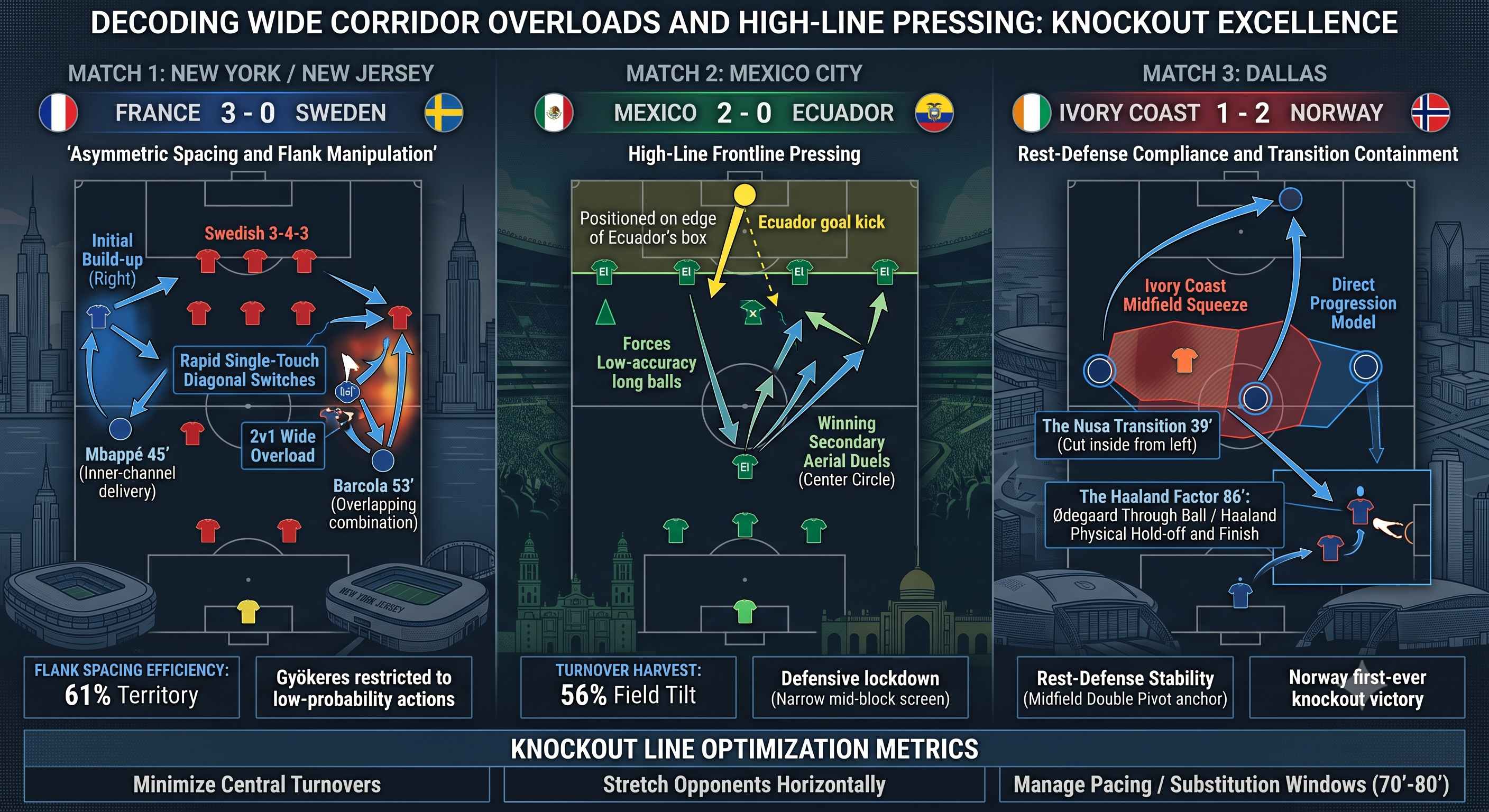
Didier Deschamps’ Les Bleus delivered a premier display of wide isolation efficiency, systematically unpicking Jon Dahl Tomasson’s defensive setup. Sweden structured their platform in an unconventional 3-4-3 alignment, intending to trap French progression along the touchlines. However, France manipulated this approach by utilizing asymmetric spacing to create immediate 2v1 overloads in the wide corridors.
- The Left-Side Isolation: France focused their initial build-up sequences down the right wing through Ousmane Dembélé, drawing Sweden’s horizontal defensive coverage across the pitch. Once the Swedish block shifted, France executed rapid single-touch diagonal switches to isolate Bradley Barcola and Kylian Mbappé against exposed wide defenders.
- The Spacing Breakdown: The strategy yielded a decisive breakthrough in the 45th minute. Mbappé tracked an inner-channel delivery, unpicked the central pairing, and fired a low drive past Jacob Widell Zetterström. This forced Sweden to extend forward after the interval, ruining their compact shape.
- The Final-Third Squeeze: France capitalized on the vacant vertical lanes. Barcola doubled the advantage in the 53rd minute via an overlapping combination, before Mbappé finalized the 3-0 scoreline in the 74th minute. France completed the match with a 61% territory edge, maintaining a flawless rest-defense layer that restricted Sweden’s star forward, Viktor Gyökeres, to low-probability perimeter actions.
High-Line Frontline Pressing at the Azteca
Mexico 2 – 0 Ecuador (Mexico City Stadium)
Driven by an intense home-soil atmosphere in the capital, Javier Aguirre’s Mexico lineup executed a relentless high-line press to choke Ecuador’s build-up structures at the source. Sebastian Beccacece’s Ecuador setup had previously demonstrated extreme low-block resilience, but they struggled against the synchronized front-line squeeze implemented by El Tri.
- Choking the Base Build-Up: Mexico positioned their advanced forward line directly on the edge of the box during Ecuador’s goal-kick routines. This restricted short passing options to Ecuador’s central defenders, forcing them into low-accuracy long balls.
- The Turnover Harvest: By winning the secondary aerial duels in the center circle, Mexico maintained an ongoing 56% field tilt. This territorial dominance allowed the hosts to build sustained attacking pressure, unlocking the Ecuadorian defense twice through rapid vertical combinations before dropping into a secure mid-block screen.
- The Defensive Lockdown: Once ahead, Mexico abandoned their high press, dropping into a narrow shape that forced Ecuador into an unproductive wide circulation loop. Frustrated by the lack of inner-lane passing entries, Ecuador’s tracking discipline dissolved, allowing Mexico to register a clean sheet under immense tournament stress.
Rest-Defense Compliance and Transition Containment in Texas
Ivory Coast 1 – 2 Norway (Dallas Stadium)
A grueling intersection of athletic counter-pressing and localized spatial manipulation took place in Arlington, where Norway secured their first-ever knockout victory in tournament history. Facing Emerse Faé’s highly physical Ivory Coast squad, Ståle Solbakken adjusted Norway’s identity, preferring a direct progression model that bypassed the Ivorian midfield squeeze.
- The Nusa Transition: Norway established control in the 39th minute through an explosive counter-attack. Wing wizard Antonio Nusa manipulated a high turnover, cut inside from the left channel, and fired a precise effort past Yahia Fofana.
- The Midfield Suffocation: Ivory Coast responded aggressively after the interval, pushing Franck Kessié and Ibrahim Sangaré high to pin Norway inside their own defensive third. The persistent pressure yielded an equalizer in the 74th minute when substitute Amad Diallo capitalised on a loose clearance to slot home.
- The Haaland Factor: Unlike the heavyweights who suffered from spatial fatigue, Norway maintained pristine structure. In the 86th minute, Martin Ødegaard unpicked the Ivorian line with a vertical through ball, releasing Erling Haaland. The elite forward held off his defender to smash home his 5th goal of the tournament, locking down a historic 2-1 win.
Knockout Line Optimization Metrics
The performance baselines across yesterday’s slate confirm that survival in the single-elimination grid relies on minimizing unforced turnovers in central zones. Teams that adjusted their pacing profiles to protect their backlines successfully avoided the extra-time strain that compromised earlier competitors.
- Flank Spacing Efficiency: France and Mexico proved that stretching the opponent horizontally prevents central bottlenecks, creating clean entries into Zone 14.
- Rest-Defense Stability: Norway’s ability to remain structurally solid after conceding an equalizer highlights the value of anchoring a midfield double pivot directly ahead of the center-backs during defensive cycles.
- Pacing the Block: Managing substitution windows to introduce fresh wide assets between the 70th and 80th minutes remains the premier strategy for breaking deadlocks without risking spatial collapse.
Over to You: Did France’s clinical wing isolation prove that standard defensive blocks cannot survive high-volume territory tilt in single-elimination play, or did Mexico’s high-line press demonstrate that home atmospheric variables are the single ultimate factor in shifting knockout geometry? Drop your precise tactical metrics and technical breakdowns in the comments below!

Leave a Reply