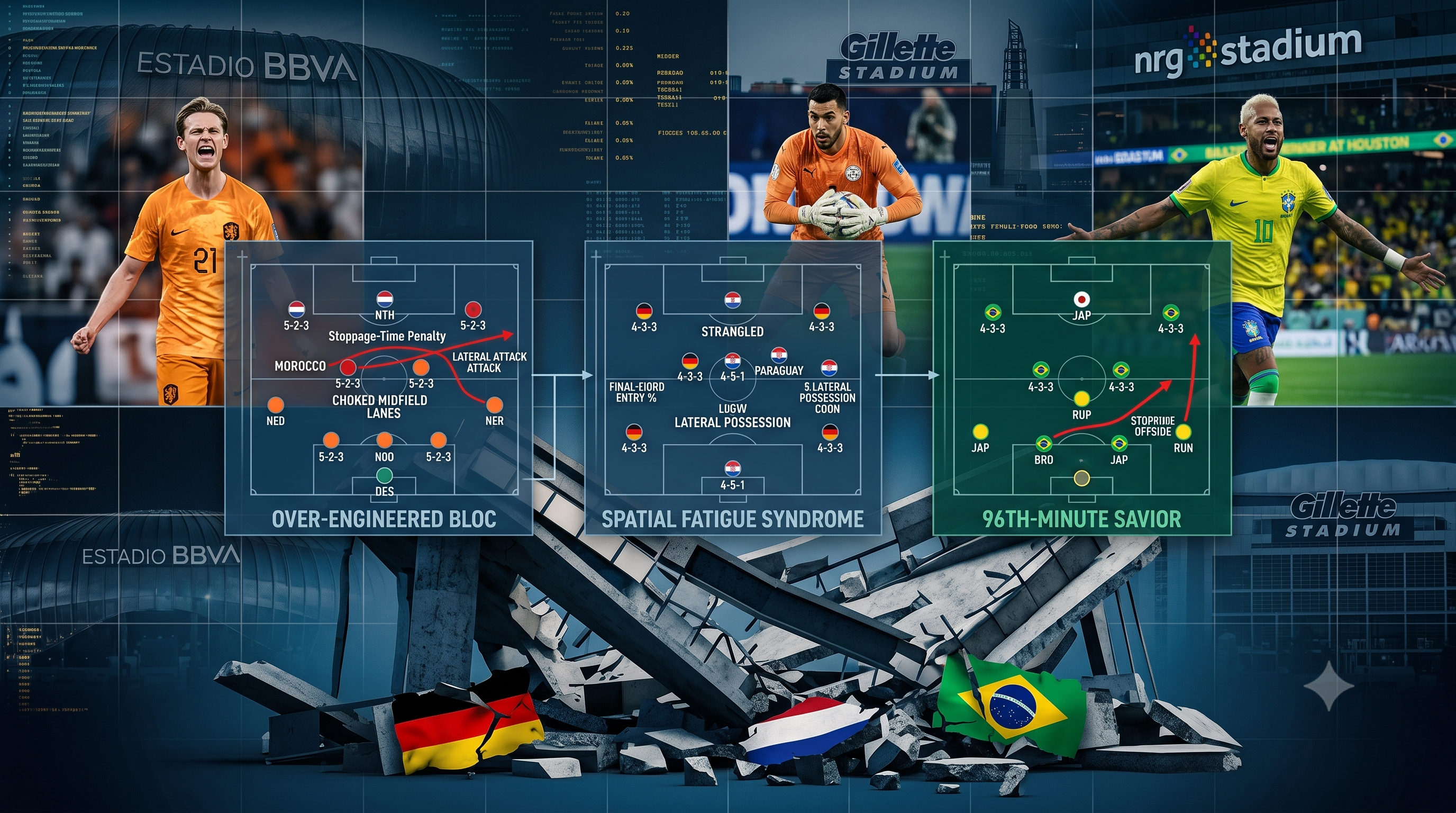
Yesterday’s extraordinary slate completely shattered the pre-tournament bracket projections, delivering exactly what the zero-margin matrix promises: the elimination of teams that over-calculate their tactical structures. In a single matchday, Germany and the Netherlands were erased via consecutive penalty shootouts, while Brazil required a 96th-minute stoppage-time savior to bypass Japan’s defense.
For technical analysts, these matches offer an architectural autopsy of how elite setups break down under tournament stress. When point accumulation safety nets disappear, mechanical alignment errors carry immediate terminal penalties.
Deconstructing the Heavyweight Erasures in Monterrey and Boston
Netherlands vs. Morocco (Estadio BBVA, Monterrey)
The structural fallout in Mexico highlighted the danger of over-engineering a team’s natural shape. Ronald Koeman abandoned the traditional Dutch four-back base to run an uncharacteristic 5-2-3 formation, aiming to restrict Morocco’s wide progression lanes. Instead, these adjustments choked the Oranje’s own final-third entry counts.
- The Overloaded Low Block: By sacrificing an extra midfield pass receiver to stock the defensive line, the Netherlands struggled to advance through Morocco’s initial press. The lack of central links left Cody Gakpo isolated, though the forward managed a clinical 72nd-minute breakthrough to put the Dutch ahead.
- The Stoppage-Time Penalty: Rather than maintaining possession tilt, the passive five-back framework invited extreme spatial pressure. Morocco utilized short lateral sequences to pull the Dutch line wide. In the 90th minute, defender Issa Diop exploited a tracking delay to sweep home a dramatic equalizer.
- The Shootout Collapse: Forced into spot-kick parameters, the psychological toll of the late collapse showed. Yassine Bounou guarded his line with precision as Justin Kluivert, Quinten Timber, and Crysencio Summerville all failed to convert, allowing Ismael Saibari to seal a historic 3-2 shootout victory for the Atlas Lions.
Germany vs. Paraguay (Gillette Stadium, Boston)
Julian Nagelsmann’s Germany lineup entered bracket play as a statistical benchmark for final-third entries but was systematically dismantled by Gustavo Alfaro’s grueling mid-block screen. Paraguay set up a rigid, low-risk 4-5-1 shape that refused to extend forward, strangling Germany’s half-space triangles.
- Bypassing the Cover-Shadow: Germany dominated 68% of the ball but spent long stretches circulating possession sideways. In the 42nd minute, Paraguay struck against the run of play. Matías Galarza delivered an accurate cross following a recycled corner, allowing Julio Enciso to head home a shocking opener.
- The War of Attrition: Germany responded with aggressive adjustments after the interval. Florian Wirtz slipped a clever ball down the left channel for Kai Havertz to level the scoreline in the 54th minute. Germany pushed bodies high to prevent penalties, even seeing a late Jonathan Tah strike ruled out for a tracking foul, but Paraguay’s low-block shield held firm through 120 minutes.
- The Spatial Fatigue Factor: In the shootout, Orlando Gill delivered a premier display of goal-line reaction, denying Havertz on the opening kick. Subsequent misses from Nick Woltemade and Tah broke the German line completely, leaving José Canale to calmly slot home the winner for a 4-3 spot-kick triumph.
Brazil’s Stoppage-Time Escape in Houston
Brazil vs. Japan (NRG Stadium, Houston)
While the European heavyweights fell to defensive containment units, Brazil managed to survive a masterclass in geometric synchronization from Hajime Moriyasu’s Japan. The Asian representatives deployed a fluid 3-4-3 platform that squeezed Brazil’s central outlets and forced unforced turnovers.
- The Transition Trap: Japan executed their high-line press with extreme discipline. In the 29th minute, central midfielder Kaishū Sano intercepted a loose touch, advancing rapidly to fire an angled effort past Alisson Becker to shock the Seleção.
- The Midfield Squeeze: Brazil manager Dorival Júnior adjusted his pacing at half-time, introducing Endrick to create central overloads. The territorial tilt yielded an equalizer in the 56th minute when veteran Casemiro drove home a regular finish from the edge of the area. However, Japan simply dropped into a narrow cover-shadow block, choking Zone 14.
- The 96th-Minute Saving Trigger: With extra time looming, Brazil’s wide isolation system finally broke the block. Gabriel Martinelli, introduced off the bench, completed a brilliant diagonal tracking run. Bypassing the Japanese offside trap in the 96th minute of stoppage time, the winger collected a vertical pass and slotted it home to secure a narrow 2-1 escape.
Tactical Adjustments and Extra-Time Pacing: The Elimination Grid Reality
Yesterday’s metrics confirm that single-elimination parameters completely neutralize historical squad-value advantages. Teams that cede possession to protect central defensive layers are thriving, while expansive setups that fail to organize their rest-defense lines are being punished on the counter.
Post-Match Structural Baseline Shifts
- The Back-Five Paradox: Adding structural defensive layers frequently compromises midfield progression, trapping possession-heavy teams in unproductive side-to-side loops.
- Pacing and Fatigue Strain: Extending into a 120-minute framework drains tactical precision. The drop in spot-kick efficiency from elite executioners like Germany underscores the extreme cognitive and physical fatigue of knockout play.
- Wide Corridor Isolation: When central lanes are tightly squeezed, match progression relies on substitute wingers with the raw acceleration to exploit low-block margins deep in added time.
Over to You: Did Ronald Koeman’s unexpected back-five structural shift actively invite the spatial collapse that sealed the Netherlands’ fate, or did yesterday’s results prove that single-elimination parameters completely neutralize historical squad-value advantages? Drop your precise tactical metrics and technical breakdowns in the comments below!

Leave a Reply