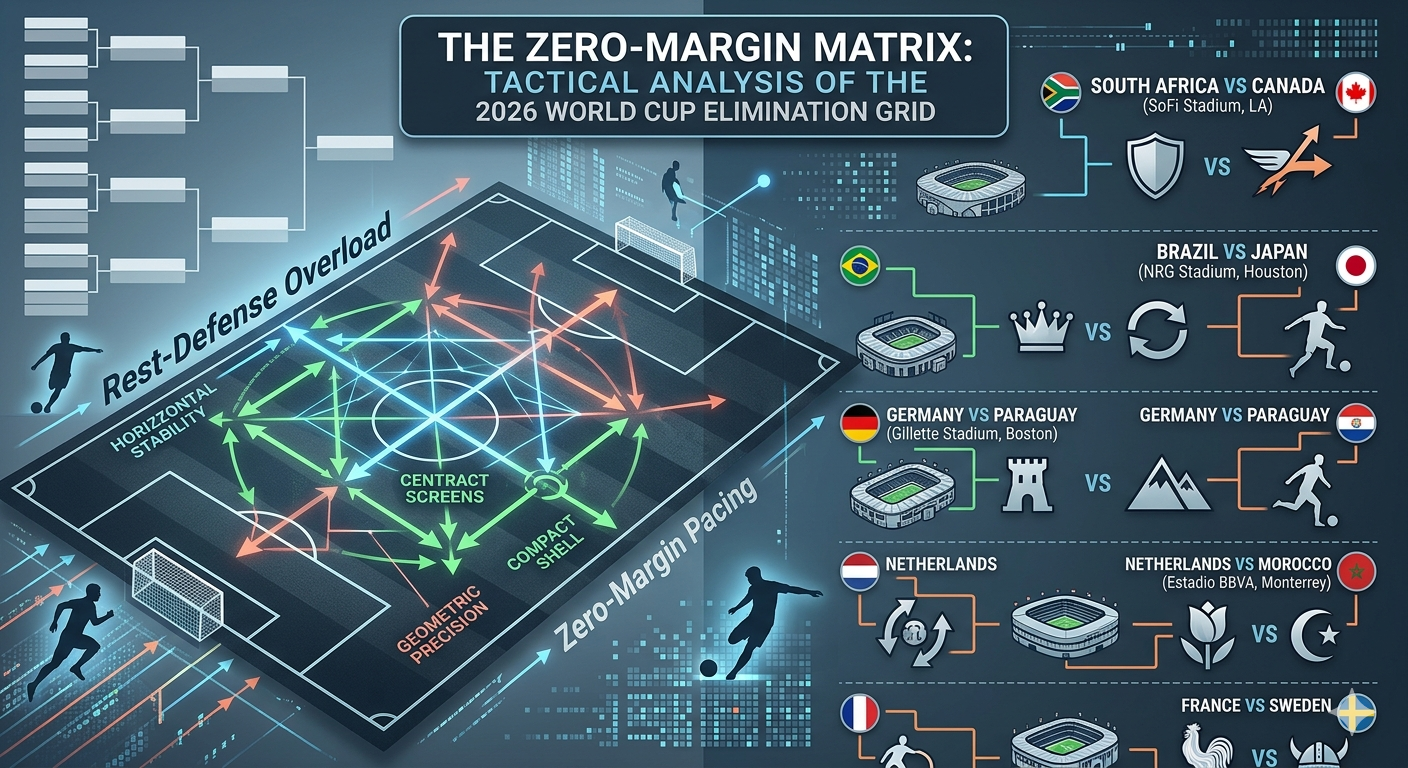
The multi-bracket group stage has officially concluded. The point-accumulation tables, wildcard third-place calculations, and goal-differential cushions have vanished, leaving behind a single-elimination grid. For technical analysts and serious observers of sporting architecture, this structural shift alters the geometric principles of team deployment.
When a draw is removed from the permissible list of outcomes, manager psychology undergoes a profound adjustment. During the opening round, a defensive tracking error or an inefficient final-third block could be corrected in subsequent matches. In the Round of 32, a solitary positional breakdown carries an immediate terminal penalty. This zero-margin framework forces coaching setups to prioritize horizontal stability and rigid rest-defense screens over expansive, high-risk territory overloads.
Analyzing the Opening Bracket Clashes in Los Angeles and Houston
South Africa vs Canada (SoFi Stadium, Los Angeles)
The single-elimination phase opens with an exceptional stylistic mismatch in California. Hugo Broos’s South Africa lineup shocked the tournament structure by securing progression via a highly disciplined, low-risk defensive shell. Bafana Bafana proved that compressing central pockets can neutralize superior individual pacing, keeping opponents isolated in low-efficiency wide channels.
- The South African Low-Block Shell: Expect South Africa to implement a deep 4-2-3-1 screen that collapses into a temporary five-man backline during extended defensive cycles. The midfield double pivot will remain anchored directly in front of the center-backs, focused entirely on blocking vertical passing lanes.
- Canada’s Structural Width: Canada advanced from a highly competitive segment by utilizing explosive flank transitions and high cross volumes. Jesse Marsch’s side relies on advanced fullbacks creating numerical overloads along the wide corridors.
- The Tactical Chess Match: The operational problem for Canada centers on unpicking a block that refuses to extend forward. If Canada commits too many bodies into the penalty box early, they risk exposing massive central vacancies for South Africa to exploit via rapid lateral long deliveries.
Brazil vs Japan (NRG Stadium, Houston)
This fixture represents a classic confrontation between technical territory control and hyper-efficient mid-block pressing traps. Brazil cruised through their opening assignments by running a fluid 4-3-3 shape designed to dominate possession and pin opponents deep inside their own territory.
- Brazil’s Rotational Fluidity: The South American heavyweights create shooting space through constant rotational switches between their advanced wingers and central midfield operators. This lateral circulation is designed to drag opposing defenders out of their tracking assignments.
- Japan’s Transition Trap: Japan navigates tournament play through absolute geometric synchronization. Their mid-block press is designed to allow horizontal passes while aggressively jumping onto any loose central touch.
- The Key Baseline Parameter: Brazil must maintain a flawless rest-defense layer behind their attacking patterns. If the Brazilian pivot screen allows Japan to clear the initial counter-press, the Asian representatives possess the vertical passing precision to isolate the central defenders in high-stress 1v1 cycles.

Tactical Breakdowns and Predicted Lineups for the Mid-Bracket Knockout Matches
Germany vs Paraguay (Gillette Stadium, Boston)
Germany entered the knockout grid after demonstrating immense offensive variation, registering a tournament-high goal count during the primary phase. Julian Nagelsmann’s setup focuses on inner-channel triangles that create high-volume entries into Zone 14.
- Germany’s Half-Space Exploitation: The European powerhouses rely on creative midfielders slipping into the pockets between the opposition’s midfield and defensive lines. By operating behind the cover-shadow, they split central pairings open.
- Paraguay’s Physical Attrition Model: Paraguay secured their knockout berth by executing a grueling, low-tempo containment script. They focus on breaking match rhythm through physical aerial duels and aggressive touchline crowding.
- The Breakthrough Variable: The structural burden sits entirely on Germany to break the deadlock early. If Paraguay maintains a clean sheet past the 60-minute mark, the psychological strain of the zero-margin environment could force Germany into low-probability long balls, playing directly into Paraguay’s physical strengths.
Netherlands vs Morocco (Estadio BBVA, Monterrey)
This matchup brings together two of the most positionally sound tracking units in modern football, setting up a high-stakes tactical battle of attrition in Mexico.
- The Dutch Total-Control Script: Ronald Koeman’s side utilizes an asymmetric build-up model, where one fullback tucks inside to form a three-man base while the opposite flank pushes high to offer maximum width. This guarantees security against quick counter-attacks.
- Morocco’s Counter-Pressing Network: The Atlas Lions utilize a compact 4-1-4-1 block that focuses on trapping the ball along the touchlines. Once a turnover is forced, they transition horizontally with extreme speed.
- The Spatial Solution: To bypass Morocco’s touchline traps, the Netherlands must use rapid switches of play, shifting the ball from one flank to the other through a deep single-touch pivot to unbalance the Moroccan defensive alignment.
World Cup 2026 Single-Elimination Previews: Underdog Strategies and Heavyweight Threats in Dallas, New York, and Mexico City
Ivory Coast vs Norway (AT&T Stadium, Dallas)
A fascinating intersection of athletic power and localized spatial manipulation takes place in Texas, featuring two nations that adjusted their core identities to survive the group phase.
- Ivory Coast’s Midfield Squeeze: Emerse Faé’s unit functions through an aggressive central screen that focuses on physical suffocation. They seek to disrupt the opponent’s build-up patterns before they cross the center line.
- Norway’s Direct Transition Model: Norway prefers a vertical progression script that limits sideways passing. They focus on finding forward outlets early, using quick technical combinations to bypass secondary defensive lines.
- The Central Isolation Battle: The primary objective for the Ivorian defensive block is cutting off the passing angles feeding into Norway’s forward line. If the African side permits clean service into central zones, Norway’s physical box presence will dismantle their positional stability.
France vs Sweden (MetLife Stadium, New York New Jersey)
Didier Deschamps’ France lineup enters bracket play as a statistical benchmark for defensive solidity, paired with explosive wide isolation sequences.
- France’s Asymmetric Balance: France allows the opponent to circulate the ball across the backline while maintaining an incredibly rigid central midfield block. Once a retrieval occurs, they target the wide channels immediately.
- Sweden’s Flank Overloads: Sweden attacks through coordinated movements between wide midfielders and overlapping fullbacks, attempting to isolate opposing wide defenders in 2v1 scenarios.
- The Tracking Demand: Sweden’s aggressive flank positioning requires their midfielders to complete exhausting tracking runs. A failure to drop into a secure defensive block the moment possession changes will hand France’s rapid wide forwards acres of open grass.
Mexico vs Ecuador (Estadio Azteca, Mexico City)
The final matchup of the opening knockout tier features an intense continental rivalry played under immense atmospheric pressure in the capital.
- Mexico’s High-Line Territorial Press: Driven by a passionate home support, Mexico implements a relentless front-line squeeze designed to choke the opponent’s goal-kicks and force immediate turnovers close to the penalty area.
- Ecuador’s Low-Block Resilience: Ecuador counteracts high-pressure systems by running a disciplined five-back formation that minimizes space behind the line. They rely on raw speed along the corridors to relieve pressure.
- The Operational Pacing Choice: Mexico faces a delicate strategic paradox. Maintaining a high-volume press for the full 90 minutes risks draining their physical reserves, exposing them to late defensive tracking delays if the fixture extends into an extra-time framework.
How Managers Optimize Squad Depth in Knockout Tournament Play
Survival in the elimination phase relies on structural compliance rather than sheer attacking volume. The teams that advance to the subsequent rounds will not necessarily be those that manufacture the highest shot counts, but the ones that maintain flawless defensive rest-defense layers when possession turns over.
As managers adjust their substitution windows to preserve energy for a potential 120-minute curve, the opening phases of these matches will likely resemble tactical chess games. The group stage provided the entertainment, but the Round of 32 will be decided by cold, geometric precision.
Over to You: Will the transition into the single-elimination framework force high-volume attacking sides to drop their aggressive counter-pressing setups in favor of secure mid-block stability, or will tournament heavyweights double down on territory tilt to secure early leads? Drop your precise structural forecasts and technical breakdowns in the comments below!

Leave a Reply