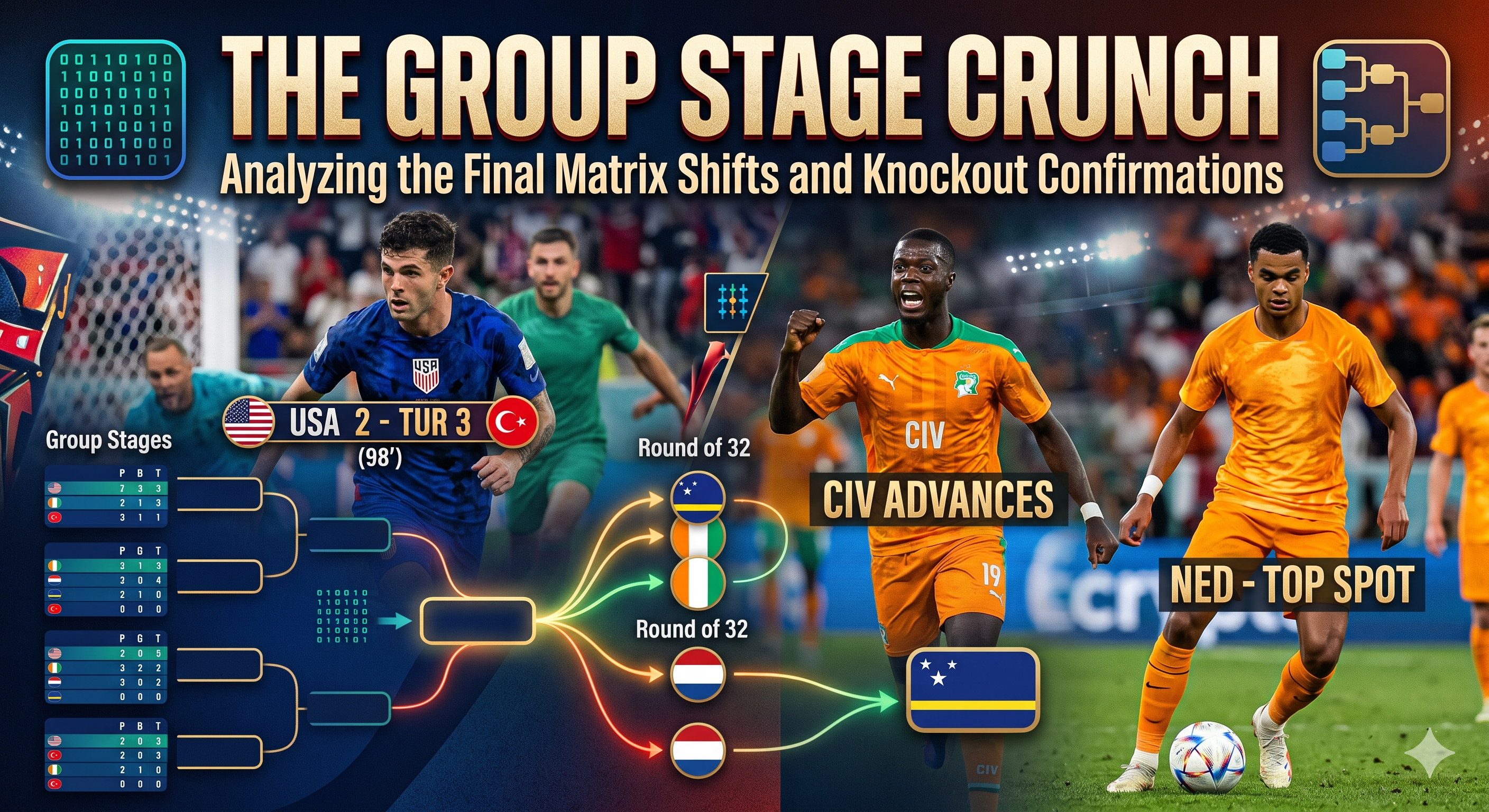
The conclusion of the final round of fixtures across Groups D, E, and F completely transformed the tournament landscape, moving teams away from group-stage calculation and directly into bracket survival. A dramatic matchday saw heavyweights solidify top seeding, unheralded underdogs break historic block barriers, and late stoppage-time chaos shift the qualification geometry for the Round of 32.
For tactical observers, the action was defined by aggressive positional manipulation, defensive depth tests, and high-line adjustments that left trailing backlines completely exposed. From Los Angeles to Philadelphia and Kansas City, these matches provided a masterclass in modern structural execution under the supreme stress of tournament play.
Group D: Stoppage-Time Drama and Substituted Latency
United States 2 – 3 Türkiye (Los Angeles Stadium)
The host nation suffered its initial defeat of the campaign in California, falling to an eliminated but highly resilient Turkish side on the final kick of the match. Setting up in an initial 4-1-2-3 build-up framework, head coach Mauricio Pochettino fielded nine new starters for this low-stakes fixture, exposing significant structural vulnerability in transitions.
- The Early Advance: Auston Trusty sparked the match early, meeting a corner delivery inside the opening three minutes to make the stadium shake. The strike marked the Americans’ seventh goal of the tournament, matching their scoring record for any group stage before bracket play begins.
- The Second-Line Squeeze: Vincenzo Montella’s Turkish squad responded immediately through an excellent two-man combination from Barış Alper Yılmaz and Real Madrid starlet Arda Güler, who pulled the strings to set up Orkun Kökçü for a 2-1 half-time advantage.
- The Technical Breakdown: Sebastian Berhalter equalized with a vicious 20-yard strike in the 49th minute. Christian Pulisic returned from a calf injury as a substitute, injecting dynamic flank pacing and rattling the goalpost. However, a late defensive tracking error allowed Can Uzun to slide a pass across the face of the goal to Kaan Ayhan, who converted in the 98th minute. Despite the loss, the USA advances as Group D winners, while Turkey exits with a proud performance.
Paraguay 0 – 0 Australia (San Francisco Bay Area Stadium)
The companion Group D fixture in Santa Clara was a physical battle of attrition that finished in an energetic scoreless tie. Australia controlled long stretches, utilizing fullbacks and wide corridors to threaten Paraguay’s deep defensive block. Jackson Irvine tested Orlando Gill early, but the South American backline battened down the hatches perfectly. The draw secures second place for the Socceroos, booking their passage to Dallas for the Round of 32.
Group E: Historical Breakthroughs and Dual-Goal Isolation
Curaçao 0 – 2 Ivory Coast (Philadelphia Stadium)
The single biggest tactical milestone of the group belonged to Emerse Faé’s Ivory Coast, who advanced to the knockout rounds of a final tournament for the first time in their history. Running an expansive 4-4-2 platform, Les Éléphants pinned the Caribbean team inside their own half early, establishing total territory control.
- The Flank Squeeze: The structural breakthrough materialized inside seven minutes following an intense vertical squeeze. Forward Nicolas Pépé pounced on a clearance failure to slide a regular finish past Eloy Room.
- The Pocket Isolation: Running wide isolation cycles down the corridors, the Ivorians continued to choke Curaçao’s transition options. Pépé locked down the result in the 64th minute, drilling a brilliant left-footed strike from a narrow angle to secure his brace.
- The Technical Breakdown: Curaçao deployed a dense 5-3-2 shell but lacked the vertical progression outlets to exploit the wide space. The Ivorian pivot screen controlled the tempo, restricting Curaçao’s cross volume to ease their team cleanly into a June 30 round-of-32 date against the runners-up of Group I.
Ecuador 2 – 1 Germany (New York New Jersey Stadium)
Germany had already clinched Group E, allowing Ecuador to mount a furious high-line counter-press to save their tournament hopes. Goals from Angulo and Gonzalo Plata unpicked the German block, rendering Leroy Sané’s strike a mere consolation. The victory places Ecuador in a wildcard matrix waiting loop, depending on point outcomes in parallel groups to stay alive.
Group F: Defensive Collapses and Unbeaten Progressions
Tunisia 1 – 3 Netherlands (Kansas City Stadium)
The Netherlands sealed top spot in Group F by exposing Tunisia’s terminal defensive tracking lapses. Deployed in an expansive 4-3-3 shape, Ronald Koeman’s side punished Tunisia’s patient build-up attempts by executing a lethal counter-pressing script.
- The Early Structural Error: An unforced error inside three minutes saw Tunisia midfielder Ellyes Skhiri turn a dangerous Denzel Dumfries cross into his own net. Brian Brobbey doubled the lead shortly after, stabbing home his third goal of the tournament from close range.
- The Midfield Squeeze: Frenkie de Jong and Tijjani Reijnders dictated central passing lanes to isolate Tunisia’s progressive outlets. Jan Paul van Hecke settled any doubts with a 62nd-minute header to restore a two-goal cushion.
- The Negative Record: Tunisia bows out with a single point, but their 12 goals conceded represent the worst defensive group record seen at a finals since 2010.
Japan 1 – 1 Sweden (Dallas Stadium)
The final match in Arlington concluded in a highly tactical draw, ensuring both heavyweights secured a direct knockout pathway out of Group F. Daizen Maeda opened the scoring for the Samurai Blue in the 56th minute after an intense vertical squeeze. Sweden responded immediately through Anthony Elanga, who found room behind the Japanese fullbacks to level the scoreline. The result leaves the Netherlands clear at the top, with Japan and Sweden qualifying right behind them.
The Advanced Group Standings Matrix
The conclusion of these matches provides complete clarity for the initial knockout brackets. The host nations and traditional powerhouses have locked up their primary paths, leaving third-place teams like Paraguay and Ecuador dependent on goal-differential margins across parallel groups.
Over to You: Did Vincenzo Montella expose a critical lack of bench depth in the USMNT defensive screen ahead of the knockout phase, or did Nicolas Pépé’s historic brace provide the blueprint for running an efficient counter-pressing structure? Drop your precise structural notes in the comments below!
Leave a Reply