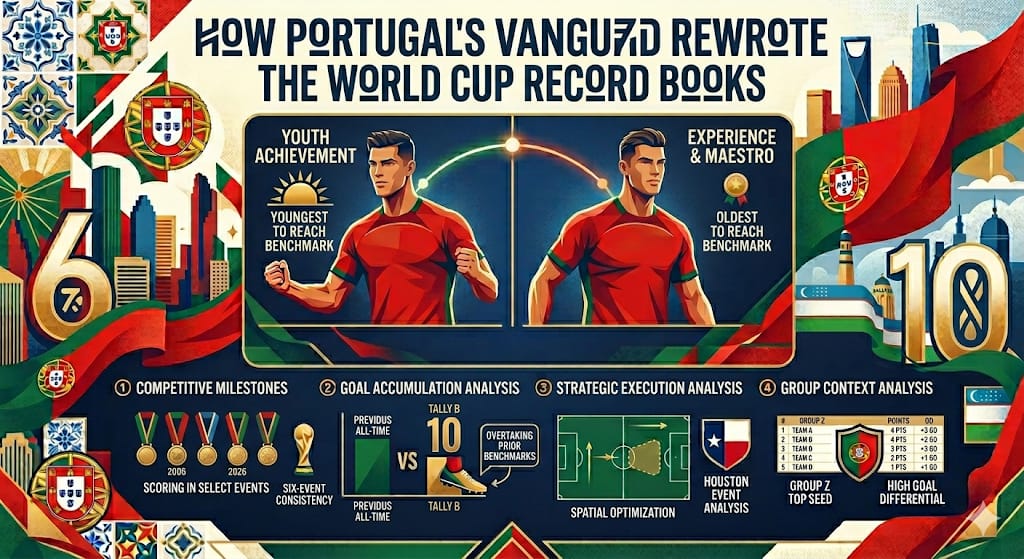
The second phase of the group stage introduced a total tactical demolition in Texas as Portugal’s veteran captain answered his critics in definitive fashion. Following a difficult opening match against DR Congo, Roberto Martínez’s lineup secured a dominant 5-0 victory over Uzbekistan at Houston Stadium. While the volume of the scoreline represents a vital strategic asset for Group K seeding, the historical reality centered entirely on a legendary individual performance that dismantled multiple international benchmarks in a single evening.
By unpicking the opposition block twice, Cristiano Ronaldo established an unprecedented standard for longevity, surpassing ancestral icons while locking down his position as the ultimate statistical outlier in Portuguese football history.
Unlocking the Hexa-Edition Benchmark
The opening phase of the tournament generated heavy debate regarding the physical role of an aging talisman within a high-line counter-pressing network. However, the structural adjustments implemented by Martínez in Houston prioritized horizontal pitch-stretching, generating the exact pocket-space required for the captain to operate with clinical efficiency.

The breakthrough materialized in the 6th minute when a crisp vertical sequence allowed the forward to slip past the defensive cover-shadow and fire a regular finish home. That moment settled the tactical anxiety surrounding the Seleção and established an unprecedented milestone. Ronaldo became the first male footballer in history to score in six separate World Cup final editions, stretching his tournament scoring timeline from 2006 to 2026. This feat cements his name at the absolute peak of international persistence, proving that spatial economy can override physical latency.
Bookending a Generation: From Youngest to Oldest
The true depth of this achievement is highlighted by a unique statistical symmetry that brackets the captain’s international career. Finding the net at 41 years old does not merely extend his current international scoring record; it creates a generational bookend that will likely remain untouched for decades.
- The 2006 Foundation: Ronaldo originally claimed the record as Portugal’s youngest-ever World Cup goalscorer during his debut tournament in Germany, converting a penalty against Iran as a rising 21-year-old winger.
- The 2026 Pinnacle: By hitting a first-half brace against Uzbekistan in Texas, the veteran forward simultaneously locked down the record as Portugal’s oldest-ever World Cup goalscorer.
- The Longevity Gap: Holding both records concurrently demonstrates an elite 20-year span of elite execution, showing how a touchline speedster successfully transformed into a central box predator.
This generational bridge highlights a complete transformation in his technical deployment. Where the young attacker relied on explosive acceleration to unbalance fullbacks, the current iteration operates through supreme pocket navigation, letting advanced fullbacks handle the tracking load while he occupies central defenders.
Overtaking the King: Surpassing Eusébio
While the six-tournament scoring record rewards pure longevity, the 38th minute of the match introduced a shift in historical rankings. Following a sharp progressive sequence orchestrated by Bruno Fernandes through the central channel, Ronaldo timed his vertical run perfectly to latch onto a through ball and slide home his second regular finish of the night.

This second blow took his career World Cup goalscoring tally to 10, officially moving him past the legendary Eusébio to become Portugal’s outright leading goalscorer in World Cup history. Eusébio had held the premium benchmark since his historic 9-goal surge during the 1966 tournament in England. While the “King” achieved his tally across just six matches, Ronaldo’s ascent to 10 goals over 24 appearances emphasizes a relentless ability to sustain final-third efficiency across multiple tactical eras.
Shifting the Group K Qualification Matrix
The high-volume 5-0 victory recorded in Houston has completely rewritten the qualification projections for Group K, lifting Portugal out of the mid-table congestion that followed their opening match draw.
By manufacturing a +5 goal-differential cushion, the Seleção have insulated their squad against final-round variance, positioning themselves safely to secure a premium knockout pathway on the Round of 32 matrix. The performance proves that when wide corridors are properly stretched, an experienced finisher remains a devastating weapon against low-block templates.
Over to You: Did Roberto Martínez discover the ultimate tactical template to maximize his talisman by stretching wide corridors, or did Uzbekistan’s choice to defend in a back-three shell simply grant Portugal too much geographical freedom between the lines? Drop your precise structural breakdowns in the comments below!

Leave a Reply