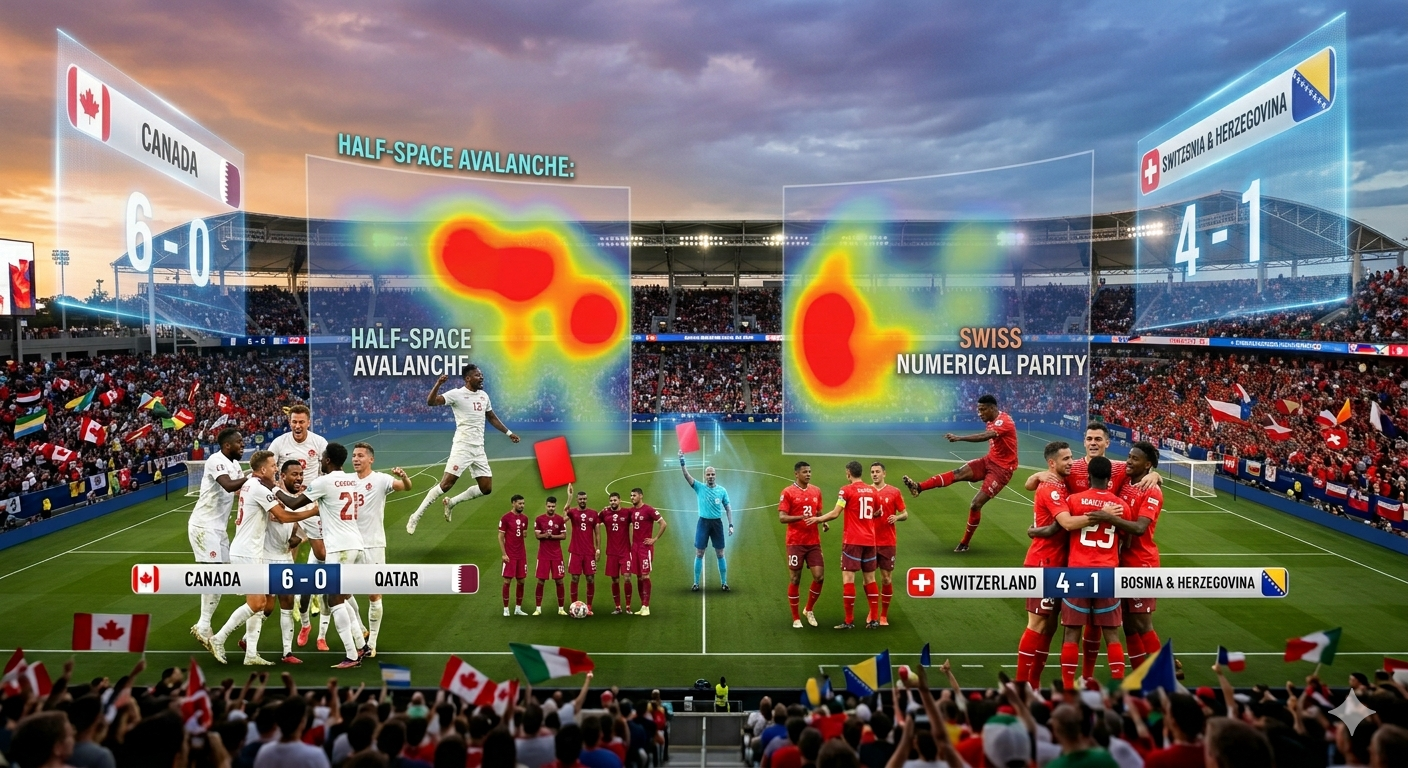
The transition from the initial round of fixtures into the high-stakes pressure of Matchday 2 completely altered the tactical temperature of this summer campaign. While the tournament’s opening matches focused heavily on low-risk defensive block configurations and containment, Day 8 generated a complete explosion of structural variance across Groups A and B. Rather than settling for cautious lateral possession chains, elite managers took full advantage of the expanded tournament format’s seeding metrics, recognizing that maximizing goal-differential margins represents a vital strategic asset.
For tactical observers, the action was defined by aggressive positional manipulation, severe disciplinary breakdowns, and vertical adjustments that left trailing backlines completely exposed. From Canada’s absolute destruction of Qatar in Vancouver to a sensational substitute performance in Los Angeles, Day 8 provided a masterclass in modern spatial disruption.
Group A: Defensive Cover-Shadows and Late Stoppage Friction
Mexico 1 – 0 South Korea (Guadalajara Stadium)
Javier Aguirre’s Mexico secured direct passage to the knockout phases by executing a highly disciplined defensive pressing scheme that completely isolated South Korea’s primary transition outlets. Setting up in an initial 4-1-2-3 build-up framework, El Tri targeted the visitor’s back-three structure, establishing an intense central press that pinned the Asian heavyweights inside their own half.
- The Goalkeeping Trigger: The definitive breakthrough arrived in the 50th minute following an unforced structural error by Korean keeper Kim Seung-gyu. Under heavy vertical pressure from Mexico’s frontline, an errant distribution landed cleanly at the feet of Luis Romo, who punished the mistake by slotting home a precise finish.
- The Half-Space Shadow: Following the opener, Aguirre shifted his midfield lines into a deeper central screening role. This move effectively neutralized the technical space available to South Korea’s attacking lines, completely cutting off the passing corridors to their wingbacks.
- The Technical Breakdown: South Korea attempted to transition into a direct high press late on, bringing on central targets to meet vertical aerial deliveries. However, goalkeeper Raúl Rangel delivered a masterclass in box command, executing a spectacular double-save late in the half to preserve a consecutive clean sheet and lock down the top seed in Group A.
Czechia 1 – 1 South Africa (Atlanta Stadium)
In contrast to the structural control seen in Guadalajara, the secondary Group A fixture in Atlanta devolved into a frantic battle of physical attrition and late transition variance. Czechia set up in a vertical configuration designed to break South Africa’s deep block, unlocking the gate almost immediately.
- The Early Aerial Trigger: In the 6th minute, midfielder Michal Sadílek timed a late vertical run perfectly, connecting with an inswinging delivery to hit a clinical opener past Ronwen Williams.
- The Low-Block Trap: Trailing early, South Africa dropped their defensive block deeper, using a structural shape to draw the Czech press forward before hitting rapid, long-range vertical counters.
- The Technical Breakdown: Czechia attempted to freeze the tempo by introducing physical reinforcements to solidify their midfield rest-defense. However, their high defensive line cracked under late sustained pressure. In the 83rd minute, a tracking lapse inside the penalty box resulted in a penalty, which Teboho Mokoena calmly converted to rescue a massive point for Bafana Bafana.
Group B: Tactical Substitutions and Disciplinary Disruption
Canada 6 – 0 Qatar (BC Place Vancouver)
Jesse Marsch’s Canada side made modern history by securing their first-ever World Cup finals victory through a devastating display of transitional efficiency and wide isolation cycles. Deployed in a highly vertical 4-4-2 shape, the co-hosts utilized aggressive flank overloads to induce extreme tracking latency across Qatar’s retreating backline.
- The Tactical Onslaught: Cyle Larin opened the scoring in the 16th minute, turning home a rebound after an organized vertical advance. Jonathan David took the attacking phase to a world-class level, hammering home a brilliant volley in the 29th minute before stabbing in a third right before the interval. Nathan Saliba curled in a spectacular free kick in the 64th minute, followed by a Qatar own goal and a late stoppage-time strike from David to complete his hat-trick.
- The Disciplinary Fracture: Qatar’s structural shape completely fractured under Marsch’s high-line counter-press. Homam Ahmed was sent off in the 33rd minute for pulling down Tajon Buchanan, and Assim Madibo followed him down the tunnel in the 53rd minute after a reckless challenge on Ismaël Koné.
- The Technical Breakdown: This match was a classic showcase of spatial expansion under numerical parity shifts. Facing a nine-man block, Canada refused to engage in passive, lateral circulation. Instead, Marsch pushed his fullbacks higher to act as advanced outlets, completely bypassing Qatar’s remaining midfield cover-shadows. While Jonathan David became the first CONCACAF player since 1930 to register a World Cup hat-trick on home soil, the celebratory mood was severely dampened by a serious bone-snap injury to midfield anchor Ismaël Koné, which disrupted the home side’s structural celebration.
Switzerland 4 – 1 Bosnia and Herzegovina (Los Angeles Stadium)
The single most dynamic tactical evolution of Day 8 unfolded in California, where Murat Yakin’s second-half adjustments tore apart Bosnia’s rigid block. For over an hour, Bosnia managed to compress central lanes, frustrating the Swiss build-up and forcing lateral, non-progressive circulation patterns.
- The Substitution Spark: Everything shifted in the 70th minute when Yakin introduced 20-year-old forward Johan Manzambi. Moving into an asymmetrical configuration, Switzerland instantly overloaded Bosnia’s right defensive channel.
- The Disciplinary Collapse: Manzambi broke the deadlock in the 74th minute with a sensational volley. Falling behind completely fractured Bosnia’s emotional rest-structure, culminating in a straight red card for Tarik Muharemović in the 80th minute.
- The Technical Breakdown: With a +1 numerical advantage on the pitch, Switzerland launched an absolute onslaught. Rubén Vargas struck a fine second in the 84th minute, before Manzambi completed a spectacular brace in the 90th minute. Although Bosnia clawed back a late consolation goal, captain Granit Xhaka finalized the 4-1 rout by converting a late penalty deep into stoppage time, placing Switzerland in absolute control of Group B.
The Qualification Matrix: Advanced Matchday 2 Metrics
The dynamic outcomes from Day 8 have completely split the qualification math, highlighting the vast difference between elite territorial control and passive low-block containment. Mexico’s tactical masterclass confirms their position at the summit of Group A, leaving the remaining three nations in a brutal statistical tie ahead of the final group stage fixtures.
Meanwhile, Canada’s historic multi-goal surge has established an elite +6 goal-differential cushion that significantly eases their knockout seeding path. For struggling sides like Qatar and Bosnia, the luxury of passive tournament management is entirely dead; they must adopt extreme, high-variance tactical risks on the final matchday to keep their tournament hopes alive.
Over to You: Did Jesse Marsch establish the definitive blueprint for running up seeding margins under the expanded tournament format, or did Qatar’s defensive breakdown simply expose a terminal vulnerability to high-line transition traps? Drop your precise tactical breakdowns in the comments below!
Leave a Reply