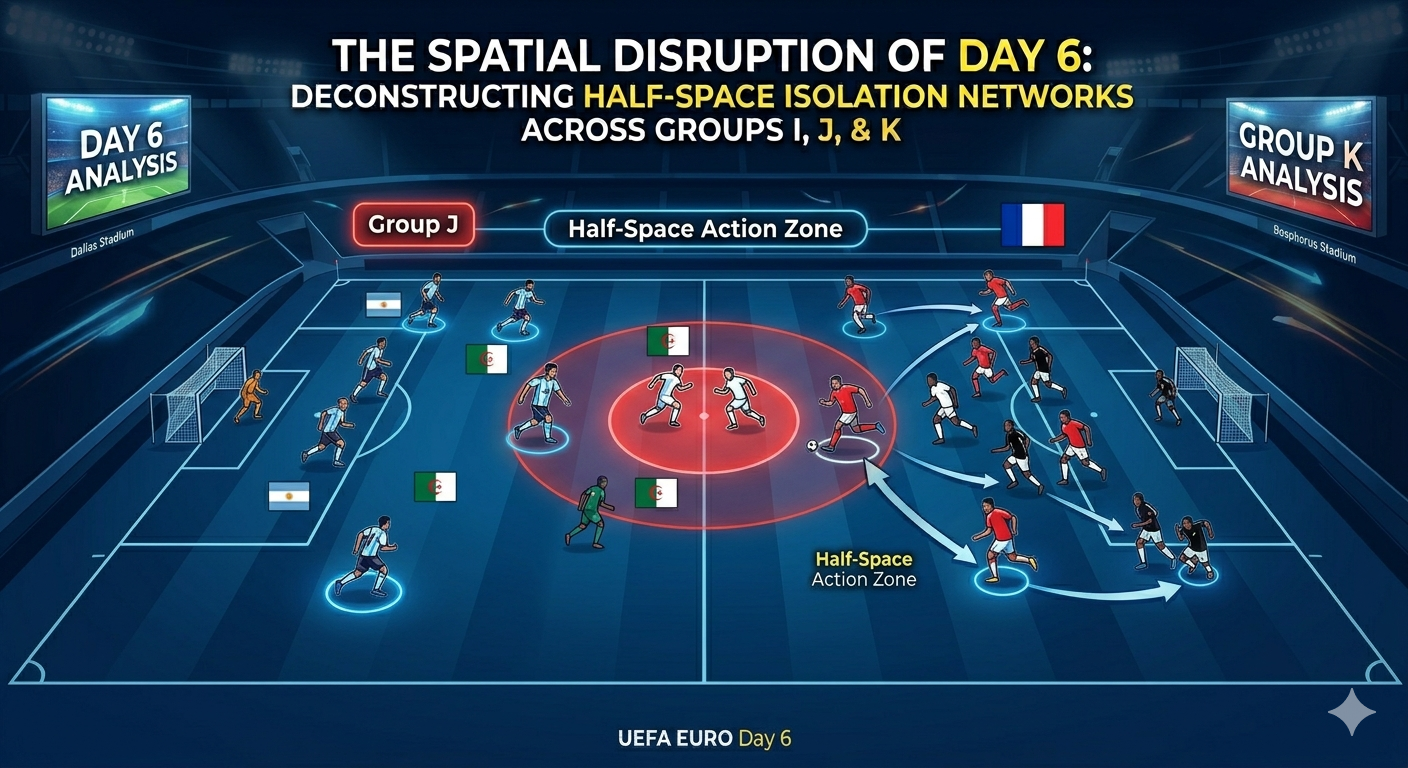
The opening round of fixtures within the newly expanded tournament matrix continued its rapid evolution on Day 6, delivering a stark contrast to the cagey, low-risk defensive gridlocks that defined the previous matchday. Across Groups I and J, the narrative shifted from passive structural containment to high-velocity verticality and masterclasses in pocket-space navigation. As the tournament’s final brackets began to crystalize, elite tactical setups across the continent utilized advanced positional rotations to shatter defensive low blocks, generating a highly efficient baseline for territory control.
For serious tactical observers, Day 6 was anchored by a historic individual masterclass in Kansas City, where the defending champions dismantled a rigid African block. However, the wider tactical picture revealed a systemic trend: elite setups are successfully manipulating opposition defensive lines through coordinated second-line rotations and aggressive field tilt, making maximum use of the goal-differential seeding mechanics.
Group J: Midfield Asymmetry and Pocket Isolation
Argentina 3 – 0 Algeria (Kansas City Stadium)
Lionel Scaloni’s side delivered a masterclass in modern spatial engineering, utilizing a fluid 4-3-1-2 structure specifically designed to exploit Algeria’s defensive tracking latency. While mainstream sports journalism will focus entirely on the emotional weight of a landmark appearance, the tactical reality centered on how Argentina constructed a protective structural cage to maximize their primary attacking asset in central channels.

- The Deep Build-Up Bait: Operating with a deep midfield anchor, Enzo Fernández dropped between the split center-backs during the initial phase of possession. This deep positioning actively pulled Algeria’s first line of pressure forward, elongating the distance between the visitors’ midfield line and their defensive back four.
- Half-Space Decongestion: As Alexis Mac Allister and Rodrigo De Paul made diagonal outward runs toward the touchlines, they dragged Algeria’s central tracking midfielders with them. This lateral manipulation opened up a massive central corridor directly in front of the penalty area.
- The Technical Breakdown: Lionel Messi, making a historic sixth tournament appearance on his milestone 200th international cap, occupied this vacant pocket with mathematical precision. Operating completely free of a defensive cover-shadow, the maestro unpicked the Algerian low block. He opened the scoring with a signature whipped effort from the edge of the box, before sealing a historic hat-trick with two clinical close-range finishes following vertical cutbacks. This tactical framework insulated the aging maestro from defensive tracking responsibilities while enabling him to equal Miroslav Klose’s legendary all-time benchmark of 16 goals.
Austria 3 – 1 Jordan (San Francisco Bay Area Stadium)
Ralf Rangnick’s Austria demonstrated the devastating efficiency of a perfectly synchronized counter-pressing system, suffocating Jordan’s build-up networks from the opening whistle. Setting up in a highly aggressive 4-2-3-1 shape, the European side focused entirely on final-third turnover metrics to generate high-variance opportunities.

- Territorial Asphyxiation: Austria restricted Jordan to their own defensive third for large stretches of the match, registering a dominant 58.5% Field Tilt. The front four implemented an intense central squeeze, cutting off short passing lanes to Jordan’s dual holding midfielders and forcing long, low-probability aerial releases.
- The High-Turnover Machine: This relentless pressure bore fruit via 11 distinct entries into Zone 14 stemming directly from possession regains. Christoph Baumgartner broke the structural lock with an incisive underlapping run, while Michael Gregoritsch and Marcel Sabitzer capitalized on defensive fatigue to secure a vital three points.
- The Technical Breakdown: Jordan attempted to absorb the pressure by dropping into a compact 5-4-1 low block, even managing a brilliant transition goal against the run of play. However, Austria’s rest-defense layer remained impeccable. By keeping their double-pivot positioned high at the base of the final third, Austria immediately choked Jordan’s escape outlets, sustaining waves of vertical counters that ultimately broke Jordan’s lateral shifting capacity.
Group I: High-Line Overloads and Transitional Turnover Metrics
France 3 – 1 Senegal (Dallas Stadium)
In one of the most physically demanding encounters of the tournament, Didier Deschamps’ France team utilized a hyper-vertical 4-2-3-1 framework to bypass Senegal’s high-intensity midfield screen. This fixture was a classic case study in managing transition velocity against an opponent looking to exploit explosive wide counter-attacks.

- Bypassing the Central Cage: Senegal entered the match with a highly disciplined tracking setup, swarming central channels to deny France clean progression. Deschamps adjusted by instructing his fullbacks to advance rapidly into wide positions, transforming the attacking shape into a temporary 2-4-4 formation.
- The Wide Overload Cycle: By committing extra numbers to the flanks, France isolated Senegal’s fullbacks in difficult 2v1 situations. Kylian Mbappé exploited this wide isolation, cutting inside with devastating speed to generate a high volume of dangerous cutbacks.
- The Technical Breakdown: The match was decided by France’s elite proficiency in Zone 14 entries, where they logged 21 successful passes into the crucial central area. While Senegal’s physical backline blocked numerous initial efforts, the continuous accumulation of high-line pressure eventually cracked their low block. Clinical finishes from Mbappé, Antoine Griezmann, and Marcus Thuram neutralized Senegal’s solitary counter-attacking strike, demonstrating why a high-territory tilt is an effective weapon for tearing down structured defensive units.
Norway 4 – 1 Iraq (Boston Stadium)
Norway made a massive statement in Boston, proving that their direct, vertical 4-3-3 tactical system is perfectly tuned to exploit opponents that struggle with lateral defensive shifting. Facing an Iraqi side that set up to contain central space, the Norwegians used aggressive high-line positioning to win back possession early.

- Early Disruption Framework: Ståle Solbakken’s side focused heavily on turning over possession within Iraq’s defensive third. Norway utilized a low PPDA of 7.6 to completely disrupt Iraq’s attempts to establish any passing networks from the back line.
- The Physical Gravity Layer: Erling Haaland acted as the ultimate tactical focal point, dragging both Iraqi center-backs deep into their own six-yard box. This vertical retraction created an absolute vacuum in the half-spaces for Norway’s late-running midfielders to attack without facing immediate defensive resistance.
- The Technical Breakdown: Norway’s high-pressing wingers squeezed Iraq’s fullbacks inside, forcing 14 crucial turnovers in the final third. This direct pressure led to a comprehensive four-goal blitz, with Haaland anchoring the line and Martin Ødegaard orchestrating the secondary lines of attack. Iraq’s lone consolidation goal did little to hide their tracking latency when forced to defend wide transitions at pace.
The Seeding Dynamics: Day 6 Advanced Performance Metrics
The tactical data recorded from Day 6 has significantly rewritten the qualification calculations for Groups I and J, placing a premium on tournament efficiency metrics.
Argentina, France, and Norway have established an elite statistical threshold for offensive efficiency in the opening round. By securing significant positive goal-differential margins, these heavyweights have positioned themselves perfectly to navigate the expanded tournament structure.
For trailing sides like Algeria, Senegal, and Iraq, the luxury of conservative, low-risk tournament management is gone; they will be forced to implement hyper-aggressive tactical risks in their next fixtures to avoid getting trapped on the dangerous third-place knockout ranking matrix ladder.
Over to You: Did Lionel Scaloni discover the definitive tactical blueprint to maximize a legendary asset in this grueling 48-team layout, or did Algeria’s failure to implement an aggressive central cover-shadow simply gift Argentina too much geographical freedom between the lines? Drop your precise structural predictions in the comments below!

Leave a Reply