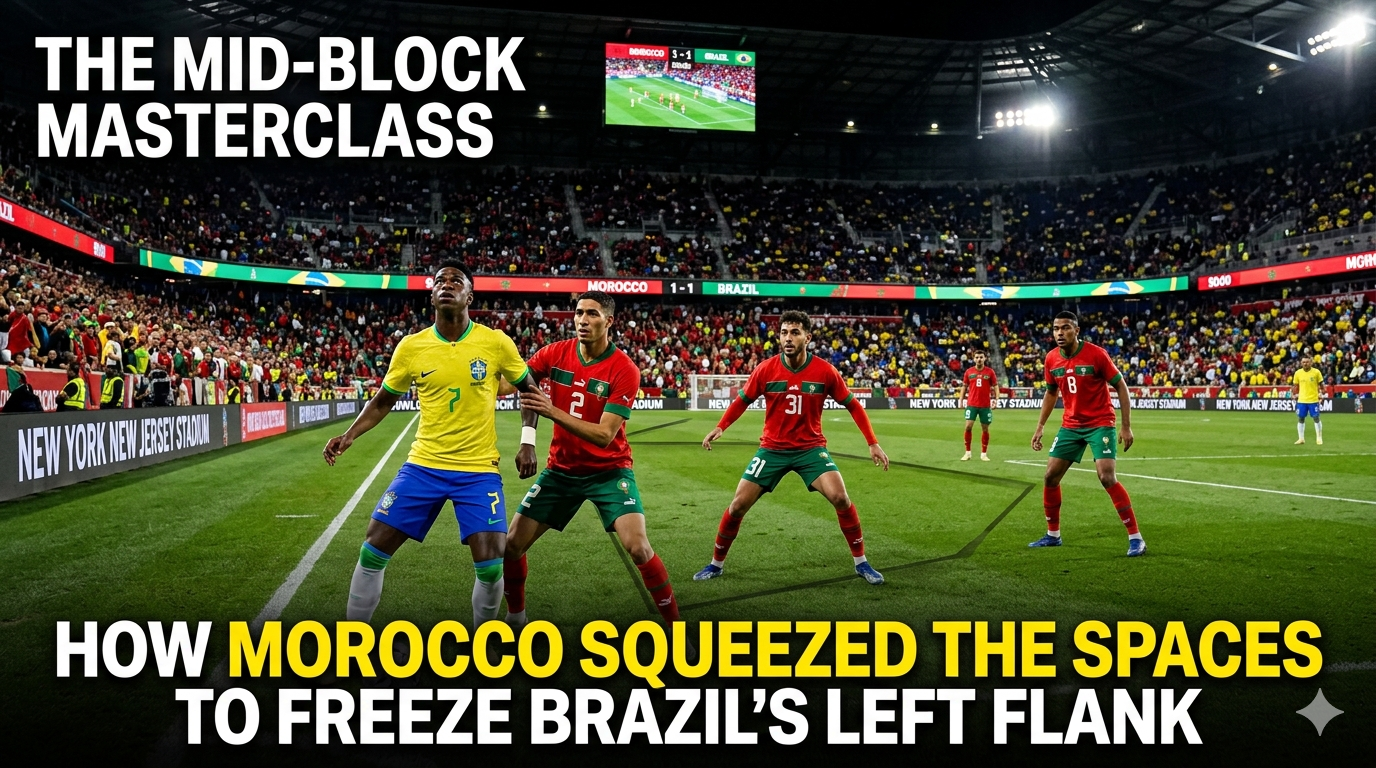
The high-stakes math of the newly expanded tournament model took center stage at the New York New Jersey Stadium as global heavyweights Brazil and Morocco fought to a rigid, highly calculated 1-1 draw. For the 80,663 fans in attendance, it was a gripping battle of structural patience. For tactical observers, it provided a pure blueprint of how compact mid-block organization can neutralize the most expensive attacking frontline in world football.
Mainstream analysis will lean into the narrative of a disjointed Seleção stumbling in Carlo Ancelotti’s historic World Cup debut as their first foreign coach. However, the reality on the pitch was far more intentional. Morocco coach Mohamed Ouahbi instructed his side to play without a shred of fear, suffocating central spaces and forcing Brazil’s elite wide options into localized structural cages.
The Early Blitz: Exploiting Defensive Imbalance
From the opening whistle, Morocco actively disrupted Brazil’s structural orientation. Rather than retreating into a passive low block, the Atlas Lions deployed a compact 4-2-3-1 setup, using intense spatial compression to trap Brazil’s double pivot. Casemiro and Bruno Guimarães found themselves constantly swarmed, struggling to establish clean passing networks under severe pressure from teenage midfield anchor Ayyoub Bouaddi.

Morocco’s early tactical aggression was evident in a blistering opening phase, racking up an impressive 12 shots in the first 30 minutes of the contest. The structural breakthrough arrived in the 21st minute following a critical unforced error in the Brazilian build-up. Lucas Paquetá lost control of an inside pass from Roger Ibañez, knocking it straight into the path of Bilal El Khannouss.
Noussair Mazraoui quickly gathered the loose ball and threaded it to Brahim Díaz in the center circle. Díaz unleashed an incisive, vertical through-ball that completely split Gabriel Magalhães and Marquinhos. Striker Ismael Saibari read the trigger perfectly, timing his run to perfection at the top of the arc before lifting an exquisite, composed chip over an advancing Alisson Becker to shock the five-time world champions.
Squeezing the Left Flank: Symmetrical Traps
Trailing early, Ancelotti’s side looked to activate their primary attacking weapon: the left-flank partnership between Vinícius Júnior and full-back Douglas Santos. Brazil’s strategy centered on creating numerical overload on the left to draw out Morocco’s back line before slipping isolated runners into the box.
Ouahbi’s defensive response was mathematically precise. Morocco refused to leave right-back Achraf Hakimi isolated in 1v1 situations against Vinícius Jr.
- The Half-Space Double-Team: The near-side Moroccan central midfielder shifted laterally into the half-space the exact moment Brazil circulated the ball wide, cutting off the inside tracking lane.
- Forced Lateral Reset: With central progressive lines completely choked, Vinícius Jr. was repeatedly forced to slow down the tempo and cycle possession back to Marquinhos or Douglas Santos, neutralizing Brazil’s transition velocity.

Despite this restrictive defensive frame, individual brilliance momentarily unlocked the gate in the 32nd minute. Vinícius Jr. exchanged quick passes with Bruno Guimarães on the left wing, found a fraction of space to cut around Neil El Aynaoui, and bent a spectacular, angled right-footed strike into the far corner past Yassine Bounou to register his 10th international goal.
Second-Half Adjustments: The Rest-Defense Chess Match
The second half turned into a rigid battle of rest-defense efficiency. Seeking greater ball retention and defensive safety against Morocco’s rapid transitions, Ancelotti executed immediate changes at the break. Fabinho replaced Casemiro to stabilize the defensive midfield line, while Danilo stepped in for Roger Ibañez at right-back to establish a more conservative defensive shape.
Brazil grew in possession dominance, pressing higher up the pitch to suffocate Morocco’s escape outlets. Yet, Morocco’s low block remained completely unyielding. Issa Diop and Chadi Riad cleared away cross after cross, forcing Brazil to attempt low-probability shots from distance.

Ancelotti threw on fresh attacking depth, introducing Matheus Cunha and Luiz Henrique in the 60th minute, but Morocco’s structural discipline holding four players behind the ball never wavered. In fact, it was Morocco that nearly claimed all three points deep into the agonizing ten minutes of stoppage time. Alisson Becker had to react with a brilliant, desperate double-save to push away Neil El Aynaoui’s long-range blast and block Ayoube Amaimouni’s immediate close-range follow-up to preserve the draw.
Group C Arithmetic and the Goal-Difference Trap
Following Scotland’s tight 1-0 win over Haiti earlier in the day, this shared point changes the qualification equation for both heavyweights. Group C now demands a completely different approach.
- Scotland: 3 Points (+1 GD)
- Brazil: 1 Point (0 GD)
- Morocco: 1 Point (0 GD)
- Haiti: 0 Points (-1 GD)

With Scotland sitting atop the table, the luxury of cautious tournament management is gone. Brazil and Morocco can no longer afford to play controlled, low-variance football in their upcoming group fixtures. Their second matches are no longer just about grinding out a win; they are forced to hunt for an aggressive goal-differential margin against Haiti to secure automatic qualification and avoid the dangerous math of the third-place matrix ladder.
Over to You: Did Morocco reveal the definitive structural template for shutting down Brazil’s wide combinations, or did the Seleção simply lack the central midfield orchestration needed to exploit the spaces between the lines? Drop your analytical breakdowns in the comments below!

Leave a Reply